Showing posts with label netgalley. Show all posts

Sunday, September 1, 2024

"We Called Them Giants" by Kieron Gillen

This is a beautifully illustrated graphic novel about disconnection, communication, power, trust, and found family.

Lori has spent a life moving from one foster family to another. Her take-away lesson from all of this is that, ultimately, people will leave you. And then they did. All of them. She wakes up one day to find streets and houses deserted - except for a school friend, Annette. They scavenge and try to survive as best they can, and avoid the gang who call themselves the Dogs.

Then one day, inexplicably, two alien craft land. The intent of their giant occupants, or their reasons for being there, remaining mysterious. Lori, Annette and Beatrice form an uneasy acquaintance with one of the giants. The giant seems benevolent, but his purpose remains unknown, and communication seems impossible, despite effort on both sides.

Then there is the inevitable conflict - which, of course, resolves by the end of the story. But there is much that remains unexplained. What caused the disappearance of a majority of the population? Where did the giants come from, and were they somehow responsible for the disappearance, or have they arrived because of it?

The story appears to be a metaphor for some of the feelings and life experience that Lori has had in the hands of a care system that has hardened her against love and attachment - and it also seems to signal this in quite a heavy-handed way towards the end of the story. But for me this made the story neither one thing nor another: there is too little detail for the story around the appearance of the giants, and I didn’t really feel the emotional connection with Lori.

So while the visuals were gorgeous, the story really wasn’t for me.

Thank you #NetGalley and Image Comics for the free review copy of #WeCalledThemGiants in exchange for an honest review. All opinions are my own.

My rating: ★★★☆☆

NetGalley Review

Wednesday, August 21, 2024

"Exodus: The Archimedes Engine" by Peter F. Hamilton

An epic space opera spanning millennia, across multiple star systems and a variety of advanced races, political machinations, and good old-fashioned humans. The skill of the author in building an intricate, inter-connected, believable set of worlds and cultures in which to set this story can’t be overstated. It’s quite an achievement.

The Set Up

The story is set 40,000 years in the future, in an area of space known as the Centauri Cluster. Playing the part of “advanced aliens” are humans that travelled to the Centauri Cluster, 16,000 light years from earth, “early” in the book’s timeline and made massive advances in technology and genetic engineering. They have highly sophisticated technology, and hugely extended lifespans. They are known as “celestials”.

And it’s just as well that they have extended lifespans, because there are no sci-fi tricks to allow anybody to travel or communicate faster than light: no hyperspace, no warp drive, no wormholes, no subspace communication. OK, so there’s one trick: a technology that allows very quick acceleration up to relativistic speeds (and deceleration), but this doesn’t change how relativistic laws still apply - including time dilation, where time passes more slowly for the people travelling than those left behind. And this is used to great effect in the story telling, where decades can pass on the planets while the plot follows some characters that are travelling between star systems.

The celestials originally arrived, as humans, in the Centauri cluster in generation ships - ships that travel at relativistic speeds, but still take millennia to travel between star systems (although it seems like less time to those on board). When they found an abundance of habitable worlds in the Centauri cluster, they sent out a “green worlds” signal to all of the other generation ships that had left earth. These ships then arrived in dribs and drabs over the next millennia, but weren’t especially welcome amongst the advanced (and now heavily populated) worlds of the Centauri cluster.

It is into this context that the latest generation ship arrives - the ‘Diligent’, which had been travelling away from the Centauri cluster when it received the “green worlds” signal, and thus has taken a somewhat circuitous route, to arrive late at the party.

And thus we have everything we need for an epic story of enormous scale. A downtrodden human population, into which new arrivals are injected. Plenty of opportunity for exposition, as the new arrivals have things explained to them about everything from technology, to politics, to celestial history. There are power structures amongst the celestials, with traditions and relationships that have spanned millennia, and are focused on retaining stability. There are secretive strategists, that have extensive information networks amongst their own, and their rivals, populations, and play the Great Game - a long game of strategy and political positioning.

And there is a rogue planet that is destined to enter one of the central star systems of the Centauri cluster, for reasons that nobody fully understands. And it is around consequences of the arrival of this planet that the main plot of the story revolves.

But Is It Good?

This book is… long. Obviously, I knew that when I started reading it. And it has to be reasonably long, given the scale and scope of the world building and the extensive cast of characters. And the length isn’t gratuitous at the paragraph level - there are no rambling descriptive passages that you can skip over. It’s wall-to-wall plot. However, the author does use plot to establish character and back-story, often telling entire sub-stories to flesh out the background of a character, technology, or organisation. The fine details of these sub-stories aren’t always important - but they might add flavour or depth to a particular character or broader sequence of events.

So to really enjoy this book, you need to be engaged and interested enough to want to immerse yourself in the sub-stories, and for those to be satisfying in themselves. This is space opera in its “soap opera” sense - where you want to hear more stories of the characters, places and organisations for their own sake, and where the advancement of the overall plot can sometimes take second place. And this is where I had a problem. I’m going to compare this to Dune and Lord of the Rings, and not in a good way. Dune, because many of the characters aren’t particularly likeable, and I’m not particularly interested in political manoeuvring and power struggles; and Lord of the Rings, because many of the side quests don’t advance the plot as much as you might hope, and if you don’t care about the culture of dwarves in Middle-Earth (for example), you’re going to find it frustrating.

But Dune and Lord of the Rings are well liked, so perhaps it’s just me.

As I said at the beginning, there is no doubting the achievement of intricate world building that this book represents. If I was rating for that alone, it would get a solid 5 stars. But my personal enjoyment was hampered by my disinterest in the themes around politics and power struggles.

This is the first part of a duology. Will I read the second part when it’s released? I genuinely don’t know.

Thank you #NetGalley and Pan MacMillan Tor for the free review copy of #ExodusTheArchimedesEngine in exchange for an honest review. All opinions are my own

My rating: ★★★★☆

NetGalley Review

Sunday, August 4, 2024

“Out of the Drowning Deep” by A.C. Wise

This is crammed with intricate, detailed and intriguing world building, which I absolutely loved. It is set in a universe where gods are revealed, angels are manifest, and prayers are a genuine and means of communication and compulsion. Meanwhile, Scribe IV, an ancient steam-punk automaton, has developed a depth of feeling and emotion beyond his original design intent. He is custodian of the Bastion, a once important but now crumbling relic, where there has now been a murder. Scribe IV calls for the help of Quin, an investigator who has troubles of his own, and a chequered and traumatic past with gods and angels.

The murder mystery is the thread that binds the plot together and gives it momentum, but isn’t really the core of the story (if you’re looking for a meaty murder mystery in a sci-fi setting, then this isn’t that book). Rather, the murder itself is just a vehicle to tell a much wider, much more interesting story. And there is so much more story to tell: Quin and his sister Lena have a dark memory from their childhood; the fearsome and powerful Sisters of the Drowning Deep have their own agenda relating to the Bastion and their sleeping god; Quin has a troubled and dysfunctional relationship with an angel, and is struggling with addiction; Scribe IV is struggling with identity and regret; and Angel is grappling with duty, honour and friendship.

The depth and complexity of the universe that the author has created is astonishing, and incredibly satisfying. My main complaint is that I wish it had been a full novel. There is so much crammed into this novella that there are too many things that I would loved to have seen given a more detailed treatment. But “I wish there was more of this!” is more of a frustration than a criticism.

Thank you #NetGalley and Titan Books for the free review copy of #OutoftheDrowningDeep in exchange for an honest review. All opinions are my own.

My rating: ★★★★☆

NetGalley review

Friday, August 2, 2024

“Key Lime Sky” by Al Hess

An intriguing and engaging cosy/mystery/thriller tale of alien invasion in small town America. Denver Bryant witnesses a UFO explode directly over the tiny town of Muddy Gap, Wyoming, but has trouble finding anyone else who saw anything, or who will take it seriously. Then people start acting strangely, and disappearing, and the weirdness gets gradually worse and more extensive. It’s a race against time for Denver to work out what’s going on and save the town… or perhaps the world.

This was a lot of fun, with a cast of likeable characters, and well paced plot. Denver is autistic and non-binary, and doesn’t always feel accepted in the small town of Muddy Gap, and this makes for a very satisfying “underdog makes good” story as Denver starts to unravel the mystery of what’s going on. There’s a small cast of supporting characters, and a bit of romance, as a “found family” starts to form amongst some of the survivors - and this all contributes to the cosy feel.

The depiction of Denver was rich, and emotionally drawn. I felt a real connection to Denver, and laughed and cried (actually cried in chapter 17) with the personal journey of friends, family, acceptance and identity. The autism seemed genuinely and sensitively depicted (although I’m no expert), and Denver’s struggles with it were well integrated into the plot and added to the depth of the character portrayal and the complexity of friendships and interactions in the small community.

The author didn’t deal with gender identity with quite the same subtlety, though, and there were a few jarring moments where some of the characters had conversations about gender issues that seemed entirely unrelated to the plot or any of the relationships between the characters themselves. There were some important and valid points being discussed (like cisphobia not being a thing), but it just felt like the author was trying to crowbar these issues into the narrative, and, for me, it came across a bit preachy. This is a minor quibble, though.

The relationship between Denver and Ezra was lovely, and felt very real - two people really seeing each other. And there was even a bit of moderately graphic smut, for those who like that kind of thing.

Overall, a very solid story told with emotion, humour, and some genuine excitement and jeopardy, somehow also dealing with autism and gender identity, all in the context of a very imaginative alien invasion storyline.

4.5 stars, rounded up.

Thank you #NetGalley and Angry Robot for the free review copy of #KeyLimeSky in exchange for an honest review. All opinions are my own.

My rating: ★★★★★

NetGalley Review

Wednesday, July 10, 2024

"In Universes" by Emet North

An incredibly imaginative and compelling tale across parallel universes, as we follow various versions of our main character, Raffi, as they search for identity, belonging, love and redemption.

The book can be seen as a set of 11 short stories involving Raffi and a loosely common set of people and situations. These are tied together by a single thread of regret about an incident with one of Raffi’s friends, Britt, when they were teenagers. The other characters - Kay, Graham, Alice - have different roles in each story: sometimes friends, sometimes lovers, sometimes just acquaintances.

Raffi is a cosmologist, with an interest and expertise in the many-worlds interpretation of quantum mechanics - the theory that the randomness of quantum mechanics is resolved by all possible outcomes occurring in alternate, newly created worlds. But that’s where the science stops - this is not really a sci-fi book, and there is no attempt to explain any mechanisms for people to travel to, or even be aware of, the alternate worlds. Rather, each story is set in an alternate universe, and any brief mention of the science just serves to guide the reader’s understanding about the loose relationship between each story. And that’s not a criticism - I actually found it a subtle but effective way to relieve what might otherwise be jarring switches of context between each story.

In most of the worlds, Raffi is dealing with feelings of loss, regret, or detachment. By the end of each story, Raffi tends to come to a conclusion that that these feels are unresolved, and wonders what life would be like in different circumstances. Each following story then takes on some of these different characteristics, but often with other significant changes - sometimes fantastical rather than realistic. And sometimes these are as a consequence of what Raffi wishes for (Monkey’s Paw style), and sometimes they are a vehicle to explore other issues (like the world in which women fracture into hordes of animals).

In one respect this is a difficult read, because each of the stories is a further exploration of these feelings of loss and regret, which remain unresolved for a majority of the book. However, this was lifted enormously by the range and breadth of imagination that the author has poured into each story. Each chapter could stand alone as a short story in its own right, with its own unique sense of character and place. Even (or especially) those with a fantastical element, where the world building was concise and compelling.

I found Raffi’s search for identity, for an authentic self, and for a sense of redemption or resolution, to be engaging and compelling. And that’s testament to the author, as I have found these themes in other books to be off-putting when they come across as the minor dissatisfactions of someone in an otherwise privileged situation. But I found Raffi’s character to be sympathetic, and these struggles of identity and authenticity to be meaningful rather than trite.

And I found the final story, with its fantastical elements, to be a fitting conclusion to Raffi’s struggles.

So why not 5 stars? Only because I found the book so difficult to pick up from time to time. And by three-quarters of the way through the book, I was finding it affecting my mood - but perhaps that in itself is an indication of the quality of the writing and emotional engagement.

This book isn’t for everyone, and I definitely need something lighter for my next read. But it is an incredibly accomplished debut work.

Thank you #NetGalley and Random House UK Cornerstone for the free review copy of #InUniverses in exchange for an honest review. All opinions are my own.

My rating: ★★★★☆

NetGalley review

Friday, July 5, 2024

“Rare Singles” by Benjamin Myers

DNF at 66%.

This is a gentle character driven observational story about an American soul singer, Earlon “Bucky” Bronco, who has had no fame at home in Chicago, but gets invited to a “Weekender” Northern Soul event Scarborough in England - due to a level of fame and adulation in the UK that he was previously unaware of. His host, Dinah, is also struggling in her home life, but finds solace in the music. Bucky battles his own demons of physical pain, drug addiction and bereavement, as he tries to find his place amongst an enthusiastic crowd of Northern Soul fans.

This should have been an emotional and engaging story. The characters of Bucky and Dinah should have felt real to me, in a way that I could have connected to. The writing style is lyrical and poetic, especially Bucky’s inner monologue - his observations of the world around him are detailed and expressive, which ought to have given Bucky and emotional depth.

But, for reasons I can’t quite put my finger on, I couldn’t connect to Bucky or Dinah - I felt like I was being told about their thoughts and feelings, rather than experiencing them. And without that emotional connection, the slow story progress and expressive, detailed passages of Bucky’s experiences and thoughts felt like wading through descriptive treacle in order to get to the next plot point. Perhaps also due to my lack of emotional engagement with the characters, the growing relationship between Bucky and Dinah also felt forced, and their moments of connection then felt slightly saccharine.

This is a shame, because I really wanted to enjoy this book, and the characters of Bucky and Dinah should be sympathetic, and have an interesting journey. In the end, I found myself skimming over descriptive passages that should have been emotionally engaging, and continuing beyond that point wasn’t going to benefit anyone.

Thank you #NetGalley and Bloomsbury Publishing for the free review copy of #RareSingles in exchange for an honest review. All opinions are my own.

My rating: ★★☆☆☆

NetGalley review

Wednesday, June 19, 2024

“Everyone I Know is Dying” by Emily Slapper

Trigger warning: suicide ideation.

This is a very difficult for me to review. On the one hand this is a very accomplished, intense, authentic and powerful portrayal of someone struggling with significant mental health issues in the context of the societal and peer pressures that young women face. And I say that with no authority, as I’m not a young woman, but that’s how it seems to me. And on the other hand, I found reading it a chore. My rating is for the quality and importance of the book that I believe that it is. And I’m attributing my lack of enjoyment down to me being the wrong audience.

Is that fair? I don’t know. It is what it is.

The book is essentially in two parts: the first part (the first 34 chapters, or roughly 90%) is an incredibly raw portrayal of the day-to-day struggles of Iris, a young woman trying to understand what happiness is, whilst searching for it in the reflected judgement of others; the second part (the final 3 chapters) is the resolution. The resolution was exactly what I expected it to be, but also the only thing it possibly could be - and is also totally fitting, given what I believe the author is trying to say.

The main body of the book is a brave, difficult, genuine, and very difficult portrayal of Iris grappling with her sense of self, identity, and worth. She sees herself only in the reaction she gets from other people; she has no genuine friendships; she is not her authentic self.

“I can’t understand why people don’t like to be seen as objects when to be seen as an object is to be desired. This is why I keep coming back”

She knows that there is something lacking in her life, and she persistently misidentifies it, bouncing from one potential source of happiness to another.

“It’s disconcerting when you realise that getting what you want doesn’t make you feel better”

There is an audience for this book, and it isn’t me. That’s not to say that I didn’t get anything from reading it - rather that there was no part of me that could identify with anything that Iris was going through. All I could really do was feel sorry for her. Perhaps I got a deeper understanding of the internal struggle related to certain types of mental health issue. But for that I need to totally rely on the authenticity of what the author is portraying (which I have no reason to doubt) rather than being able to draw on any of my own experience.

Reading the comments about this book from other reviewers makes it clear that there is an audience for this book - people who can directly relate to some of the struggles that Iris had. In the reviews I have read, there are more comments from people who directly relate to Iris, at least in some small part, than from those who don’t. And for those people, I have a sense that the portrayal of Iris has a resonance, depth, and meaning.

If I could relate to Iris, this would probably be a 5-star read. If I were to give a rating solely on my personal, subjective enjoyment of the book, it is a 3-star read. What’s a reviewer to do?

Thank you #NetGalley and HQ for the free review copy of #EveryoneIKnowisDying in exchange for an honest review. All opinions are my own.

My rating: ★★★★☆

NetGalley review

Sunday, June 9, 2024

“Inside the Mind of Sherlock Holmes” by Cyril Lieron

This is a beautiful, detailed and intricate graphic novel of an original Sherlock Holmes story. The art style was meticulous, and showed a real love of the material. Victorian London is superbly represented, and it carried a sense of mystery and untold things happening behind closed doors all the way through the book. The storytelling was excellent, and the pacing was spot on. I absolutely loved it.

My experience with Holmes is limited and mixed: the only book I have read is Hound of the Baskervilles, which I didn’t get on with; but I absolutely love the TV adaptation with Benedict Cumberbatch playing the part of Holmes. I never understood how Holmes can be so engaging, interesting, and a deductive genius in the TV adaptation, but come across as arrogant and supercilious in the book. Thankfully, the Holmes in this graphic novel comes across as the deductive genius I love so much in the TV adaptation - slightly irascible and impatient at times, but always one step ahead.

The blurb says that the book “uniquely portrays the inner workings of the greatest detective’s mind” and “every thought and clue that flows through Sherlock’s mind is thoroughly explored and displayed in the art for readers to latch onto” and it absolutely delivers on this. At several points through the book, we see inside Holmes’ “mind palace”, where he analyses the clues that he’s uncovered up to that point. In between these, the clues are represented on a visual “thread” that runs throughout the entire book, on which various clues and deductions are placed as they turn up. It’s an excellent use of the graphic novel format to show the progression of clues and their relationships. Together, these techniques allow the development of the clues and deductions to be easily followed, and I felt like I was along for the ride.

The artwork is absolutely gorgeous - fantastic use of maps of London, and incredibly atmospheric locations. I loved the use of repetition across panels (and often within the same panel) to show movement and the passage of time (I tried to find a technical term for this, and I’m not sure there is one… polyptych?).

There is a dedication to Peter Cushing at the front of the book, and the depiction of Holmes is clearly on homage to Peter Cushing’s portrayal of Holmes in the 1960’s TV adaptation. A lovely touch.

Six stars, rounded down to five.

Thank you #NetGalley and Titan Books for the free review copy of #InsideTheMindofSherlockHolmes in exchange for an honest review. All opinions are my own.

My rating: ★★★★★

NetGalley review

Tuesday, May 28, 2024

“Titan’s Tears” by Chad Lester

Unfortunately, this wasn’t for me, and I stopped reading a third of the way through.

I wish I could say what the book was about - but it eludes me, even though I’ve read a full third of it. There are two major threads: Belle has a slightly mysterious background and goes to work for the mysterious Sophia, CEO of the mysterious Ecclestone Evolution, who are doing some mysterious work. It’s a grab-bag of future tech in a callous and unfeeling world: AI that’s “orders of magnitude” more powerful than a human brain, life-extending medical breakthroughs, bringing extinct animals back to life, lack of ethics or any kind of oversight, etc; and then there is Seth, a downtrodden worker just trying to make his way in a callous and unfeeling world, after a string of personal tragedies, while everyone’s jobs are being replaced by machines and there doesn’t appear to be any employment law.

Presumably these two threads come together later in the book.

There were a few reasons why I decided not to continue with this book, but overall it’s because my lack of engagement with any of the characters, coupled with a writing style that I found to be a distracting obstacle to my enjoyment, outweighed my curiosity about what was going on.

The writing style includes a lot of exposition - we’re told about what people are thinking and feeling, rather than allowing it to unfold through the actions and reactions of the characters. For me, this contributed significantly to my lack of engagement. But then suddenly there are pages of unbroken direct dialog between two characters - just line after line of quoted speech for page after page. I lost track of who was speaking several times. Then we’re back to the ponderous exposition again.

The pacing is also extremely inconsistent. The storyline around Belle and Sophia is almost glacially slow. For chapter after chapter very little happens beyond the drip-feed of mysterious goings-on at Ecclestone Evolution (did I mention that it was mysterious?). Every so often a nugget of what’s going on is revealed, but this feels like the author is dragging it out, presumably to create suspense and intrigue, but I found it transparent and irritating. And then Seth’s storyline is at express pace - hardly has he navigated one major or traumatic life event, than he’s negotiating the next. And while there is tragedy in his story, the whirlwind of plot doesn’t allow the time or space for any kind of emotional development or engagement.

The author seems to have some broad brush political opinions about corporate behaviour, which are ladled on in big dollops in both Seth’s storyline and Belle/Sophia’s - and it’s not clear whether these would have eventually become central to the plot, or whether the author just has a bit of an axe to grind and is using this book as a platform. And at one point, one of the characters who has a history of mental illness is referred to as “backwards” by one of the other characters. So perhaps I’ll take the author’s kind offer to bestow the benefit of his opinions on me, and leave it at the door.

Kthxbye.

Thank you #NetGalley and the author for the free review copy of #TitansTears in exchange for an honest review - for which I also apologise. All opinions are, clearly, my own.

My rating: ★☆☆☆☆

NetGalley review

Friday, May 24, 2024

"Dandelion" by Sabir Pirzada

This graphic novel is a collection of ten short stories set in a world where outcasts and the dispossessed get to live their lives as “exiles” on floating capsules, “Dandelions”, with all of their living requirements met… except that they can never again land on solid ground.

This is an ambitious concept - the creation of a two tier society (in this case, as literal is it is figurative) caused by the pressures of climate change and job losses through automation. And it tries to pack a lot in: the psychological and societal impact of creating and underclass of people who are forced to live separately from the rest of society, the impact and opportunities that this will provide for criminality and surveillance, and the adjustments and sacrifices that normal people and families would have to make. Woven through this is a thread of the supposed inventor of Dandelion, Jen Nakamuto, and her reflections and regrets over the impact that the Dandelions have had.

I was looking forward to reading this. It should have been great. Unfortunately for me, it fell short of the mark. I think this is mostly due to how short each story was: ten stories in 120 pages barely allows each story to start developing before it hurtles towards its conclusion. Each story felt rushed and, leaving little space for emotional development of any of the characters or situations, with the result that I found it very difficult to engage with any of it.

This is such a shame, as the concept has the richness and potential for a novel length treatment. And there is such a collection of artistic talent; using different artists for each of the stories showcases a broad range of excellent artwork, and the change in visual style matched the change on point-of-view for each story.

Despite all of this, two things did stand out. Running between the main stories are snippets of the “Excerpt from the Statosphere podcast” interview with Jen Nakamuto. This set of reflections of the supposed inventor of the Dandelions, rendered in black and white was a nice counterpoint to the action in the main stories. And I found “The Bird” poignant and emotional (the fact that it had a talking octopus and lizard that was aware that its existence was within a graphic novel also helped). For me, though, these were just highlights in what felt overall like a missed opportunity.

Thank you #NetGalley and Image Comics for the free review copy of #Dandelion in exchange for an honest review. All opinions are my own.

My rating: ★★☆☆☆

NetGalley review

Tuesday, May 21, 2024

“Service Model” by Adrian Tchaikovsky

What do you get when you throw a whole bunch of pop culture and literature references into an irreverent buddy-movie story starring a vehemently non-self-aware robot and a plucky sidekick trying to find meaning in a dystopian wasteland?

You get a fun, fast paced adventure, with a bit of existential angst, and some robot librarians. You can also use it as a light-hearted vehicle to ponder the nature of self-awareness, and the duties and responsibilities we have around the use and nature of AI; it’s there if you want it, or you can just enjoy the ride.

Charles, the domestic service robot, is forced to find alternative employment after the untimely death of his Master. His quest takes him through the remains of a collapsing human civilisation, where the groups of surviving people and robots that he meets present an array of temptations and dangers that he must navigate in his search for meaningful employment.

The story is in five parts, and is almost episodic, in that each part roughly corresponds to our heroes getting into trouble, navigating the jeopardy (while moving the narrative forward), and then escaping to the next part of their quest. Each part also has a thematic or stylistic flavour, signposted by the loosely disguised part titles (the interpretation of which I’ll leave as an exercise for the reader), which was a nice touch, for those that I got.

Does it have flaws? Well… maybe. In the early parts of the book, I wasn’t convinced about the inflexibility of the AI to cope with novel situations. The robots are sophisticated enough to be able to cope with the ambiguity and assumptions involved in acting as a valet: organising their Master’s clothing, activities, and travel, for example. But those same robots are simultaneously incapable of dealing with the exact same levels of ambiguity in other contexts, or are debilitatingly literal - for example one robot had been waiting for years to greet some guests that it had been told would arrive, but had not been told how long to wait for them.

And there were a couple of pinch points in the plot when our heroes got themselves out of trouble in a way that made me say “Really?!” to myself.

But, for me at least, these are eminently forgivable. The inability of the robots to think outside the box is such an important thread that binds the plot together, that I was quite happy to put aside my mild incredulity (and, to be honest, if you can’t put this aside then you won’t enjoy the book). And the occasional opportunistic escape from trouble kept the plot moving, and contributed to the episodic nature of the story - which I found enjoyably reminiscent of old “Saturday morning cinema” sci-fi like Flash Gordon (but that might just be me).

The story is packed with popular culture references - and those that I spotted made me smile (”2001: A Space Odyssey”, “Star Wars” and “The Wizard of Oz” are all in there, for example). I’m sure there were many that I missed - in the same way that I didn’t get the references for all of the part titles - but that doesn’t matter. It annoys me when an author tries to show off with this kind of thing, but that wasn’t the case here - it was just a bit of extra fun.

I also really liked the tone. There is a witty irreverence that suits my preference, but in this case I also found it reminiscent of Douglas Adams and Terry Pratchett in places, which I really enjoyed.

So, despite the flaws, a solid 5 starts. I can see myself revisiting this - for the humour, the story, the robot librarians, and the philosophical exploration of the nature of free will and self awareness.

Thank you #NetGalley and Pan MacMillan / Tor for the free review copy of #ServiceModel in exchange for an honest review. All opinions are my own.

My rating: ★★★★★

NetGalley review

Monday, April 29, 2024

“Knife” by Salman Rushdie

This is an immensely personal, intimate, moving, and powerful account of 13 months in Salman Rushdie’s life. On 12 August 2022, when he is about to start a lecture at the Chautauqua Institution, a man rushes onto the stage an attacks him with a knife. This almost claimed Rushdie’s life, and cost him the sight in one eye. The book charts 13 months of the physical and emotional impact of this attack on Rushdie and those in his closest circles of love and friendship. His account of the incident, and the impact it had on his physical health, his wife and family, is eloquent and moving.

The book is divided into two parts. The first part deals with the attack itself, and the aftermath of hospitalisation and rehab. The description of the attack is intense and immediate, and feels immensely personal. The second part is reflective on Rushdie reclaiming some sense of normality, and trying to find some perspective for the incident and its ongoing impact on his life.

I knew very little about Salman Rushdie before reading this - beyond the fact of the fatwa issued in 1989 for his death, due to the content of his book The Satanic Verses. And it was the long tail of that fatwa that, ultimately, and obtusely, resulted in the knife attack. Rushdie draws on his knowledge of history, politics, art, literature, and philosophy to try to bring meaning and context to what has happened to him.

It’s difficult to find fault with such a personal, honest, introspective - and, ultimately, engaging and well told - account.

Thank you #NetGalley and Random House UK / Vintage for the free review copy of #Knife in exchange for an honest review. All opinions are my own.

My rating: ★★★★★

NetGalley Review

Thursday, April 25, 2024

“The Ministry of Time” by Kaliane Bradley

This was a compelling and engaging cross-genre combination of time-travel, mystery/thriller, historical fiction, and romance. It had a lot to pack in, and it did it very well.

According to the blurb: “In the near future, a disaffected civil servant is offered a lucrative job in a mysterious new government ministry gathering 'expats' from across history to test the limits of time-travel. Her role is to work as a 'bridge': living with, assisting and monitoring the expat known as '1847' - Commander Graham Gore. As far as history is concerned, Commander Gore died on Sir John Franklin's doomed expedition to the Arctic.”

The first half of the story is establishing Graham and the other expats in the 21st century. This part of the book is a charming fish-out-of-water tale, as the expats try to adjust to cultural and technological differences from their own time. The main expat character, Graham, is incredibly likeable. He has a laid back, sarcastic take on the world, and his dry observations of what he seems around him are insightful and often pithy. I also really enjoyed the character of Maggie, from 1665, whose joyous and boisterous reaction to the pleasures of 21st century living were delightful, and made me laugh.

I don’t generally read historical novels, so it was an added interest for me that Graham Gore was a member of the Franklin Expedition, an ill fated expedition into the arctic.

The friendship between our main character (whose name, weirdly, we never find out) and Graham grows throughout the first half of the book, and continues to blossom as the story progresses. Most of the first two-thirds of the book are taken up with establishing the characters and the romance. There’s even a bit of smut thrown in, for those who like that in their books.

As the plot develops, it becomes clear that all is not as it seems with The Ministry, and our intrepid band of expats and ‘bridges’ are both caught up in, and try to navigate, the unfolding events. The time travel elements were quite satisfying - the time travel ‘door’ isn’t fully understood by The Ministry, and the cautious approach to time travel contributed to the plot. At about 80% of the way through the story, the pace picks up, things start to come to a head, and it became a real page turner.

Only one niggle for me: I would personally have preferred a different balance between the character/romance development and the mystery/thriller elements of the plot (less romance, more plot) - especially as, despite the focus and detail on their relationship, I never really felt the emotion in the romantic relationships.

But regardless of this, it’s a cracking story, with something for everyone, and a masterful combination of genres.

Thank you #NetGalley and Hodder & Stoughton / Sceptre for the free review copy of #TheMinistryofTIme in exchange for an honest review. All opinions are my own.

My rating: ★★★★☆

NetGalley Review

Wednesday, April 10, 2024

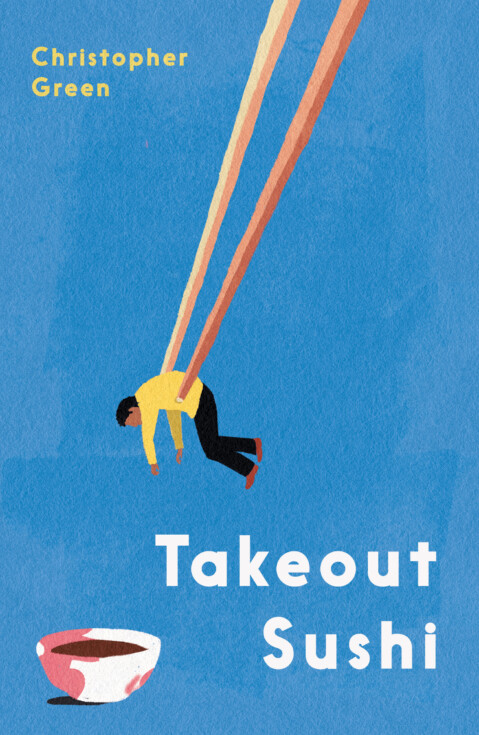
"Takeout Sushi" by Christopher Green

I’m afraid that this collection of short stories really wasn’t for me, and I left it unfinished 60% of the way through (11 of the 17 stories).

These stories are small slices of life, mostly from the perspective of a foreigner living in Japan.  Each little vignette nicely captures a mood, but, while there was a charm in many of them, the mood that was mostly captured seemed to be that of a mundane daily life.  The world being painted felt quite grey.  Unfortunately, I simply wasn’t engaged by any of the stories, and I found the outcome of most of them to be unremarkable.  There were a few times when the author teased me with a what seemed to be a tantalising moment of insight - for example, the subjective nature of “under budget, and on time” in ‘Spinning Wheels’, or ignoring the roots while being captivated by the leaves in ‘The Tree’ - but these were unsatisfyingly underdeveloped.

Maybe I’m missing the point.  Maybe the point is to immerse oneself in the grey mundanity of daily life, and enjoy these gentle fables of regret, hubris, and growth.

I did laugh out loud in ‘Burned’, though.  And the illustrations are nice.

Thank you #NetGalley and Neem Tree Press for the free review copy of #TakeoutSushi in exchange for an honest review. All opinions are my own.

My rating: ★★☆☆☆

NetGalley review

Monday, April 1, 2024

"The Other Valley" by Scott Alexander Howard

Some stand-out moments in this unique but flawed story of time travel that deals with themes of loss, obedience, conformity, consequences and missed opportunities.

3.5 stars rounded down.  I don’t usually award half stars, but I’m so conflicted about how to rate this book that I don’t feel like I have any other option.

A brief summary from the blurb:

"West is twenty years in the past.

East is twenty years in the future.

Would you travel through time to save the one you love?

Sixteen-year-old Odile Ozanne finds herself drawn into a devastating lifelong dilemma – to preserve the town’s carefully protected timeline, or to risk everything and try to rescue her one chance at happiness."

The time travel set-up interesting, and unique in my experience: the story is set in a valley bounded by mountains to the east and west.  Beyond the mountains lie the same valley, but 20 years in the past the the west, and 20 years in the future to the east.  This is an imaginative set-up for time travel.  For me, though, it left significant questions unanswered that I found an ongoing distraction (more on that later).

A feeling of disconnection

First, let’s deal with the elephant in the room: there are no quotation marks.  Direct speech is indicated by a paragraph break (although not always) along with the reader’s intuition that someone is now speaking due to the change in flow and tone.  The story is told in the first person and there were quite a few times when I was genuinely confused about whether a sentence like “I didn’t know” was part of the first person narrative, or was being spoken by the narrator, or was being spoken by one of the other characters.  I think I mostly got it right from context, but why is the author making me work so hard?

I have no problem with an author playing with convention and form for stylistic reasons or to provide a particular feel - but I simply didn’t see the point of the lack of quotation marks.  Worse than that, not only did it get in the way of the reading experience, but it also got in the way of my engagement with the story and the characters.  For me, the lack of quotation marks added distance - as if all of the speech was either badly remembered, or was being reported third-hand.  It had the disconnected feel of a badly dubbed foreign film.

This brings me to characterisation.  I’m not sure whether the main character, Odile, was supposed to be somewhat neurodivergent - with sentences like “startled, I forgot to smile back” seeming to indicate the processing of emotions being a deliberate activity - or perhaps she was just supposed to be shy.  Either way, she is written with an emotional detachment, and seems to be on the sidelines for many of her experiences and relationships with other people.  Unfortunately for me, this also meant that I had no sense of the depth of her emotion for her best friend, Edme, whose fate is pivotal for much of the plot.  I did wonder whether this was just my own disconnection with the author - that perhaps the author wasn’t going to be able to make me feel anything for any of the characters - but this wasn’t the case: I found one of the scenes where Odile escorts an old man into an adjacent valley very moving.

The Time Travel Mechanism

I had so many problems with the time travel mechanism, where valleys to the east and west are 20 years removed…

Firstly, the entire world in which the story unfolds is only a few kilometres wide, but the society is advanced enough to have buses and cars.  This means that there needs to be a certain amount of heavy industry: mining, steel works, petrochemicals, manufacturing, etc.  This is briefly alluded to at one point (“The pavement ended and the streetlights tapered off at the gloomy remains of the brickyard and some factories. There was no more need for them to operate, the Conseil said“), but a few factories isn’t enough.  Worse than this, the valley is also bounded to the north and south - the valley is the entire world.  It’s not like there is an “industrial zone” elsewhere that would explain this.  Of course, none of this is important to the plot, but I found it very distracting.

Secondly, the “single timeline” rules of time travel in this book would result in an incredibly delicate hold on a stable reality.  Changes in the past (the west) will impact the future (the east).  In fact, this is poetically described at one point: “A person goes west, he interferes, and then new time rolls over him like a wave, leaving nothing behind. It’s as simple and ruthless as that.”  This set of timeline rules is fine in principle, and is well established in speculative fiction in general.  However, when this is combined with the “walk west and you end up 20 years in the past” mechanism in this book, then the entire world becomes very fragile.  The purpose of the “Conseil” in the book is to police movement between valleys, due to the consequences to the timeline of uncontrolled attempts to interfere with the past.  However, we’re supposed to believe that the valleys go east and west without end - that they are effectively infinite.  This means that the Conseil has to have a perfect record in every one of the infinite valleys to the west in order to prevent waves of updated time continuously crashing eastwards through the valleys.  This seems unlikely.  And what about a bird (because there are birds) flying west and, for example, causing a car accident?  This delicacy of the timeline is essential to the plot, and yet is inherently infeasible.

The Good Stuff: Plot and Character

One final negative word before the good stuff: the pace is incredibly slow, and the balance of story establishment vs payoff is too skewed towards story establishment for my liking.  For me, the payoff of all of the world building and character development kicked in at 80-90% of the way through, which represents quite a lot of slogging through world building up to that point.

However, the payoff was very satisfying.  For all that I’ve criticised the distracting elements of style and world building, I found the progression of the plot (who ends up where, and for what reasons) to be surprising and enjoyable - there were points where the plot took a sharp turn in a way that I wasn’t expecting, and I really appreciated that.

The blurb would have us believe that the book is about lost love and redemption - the chance to bring back something that’s been lost.  And while it is about that, the “something that’s been lost” runs so much deeper than a relationship with a childhood friend.  Compliance to authority for the greater good in the face of personal loss is a theme that runs throughout the story.  Coming to terms with regret and lost opportunity is also a persistent thread - and a thread that is made poignant by the tantalising prospect of being able to travel back in time and interfere, in an attempt to change outcomes.  And it’s in the main character’s self-absorbed, introspective contemplation on the direction that her life has taken in the face of all of this that the author’s characterisation really shines.  Odile’s combination of regret, resignation, and conflict later in the story ultimately gave her the sense of depth and reality that I was hoping for - and that’s what will stay with me from this book.

Thank you #NetGalley and Atlantic Books for the free review copy of #TheOtherValley in exchange for an honest review. All opinions are my own.

My rating: ★★★☆☆

NetGalley review

Thursday, March 21, 2024

"Alien Clay" by Adrian Tchaikovsky

This is a gripping and fast-paced adventure set on a very alien world.  The world buiding is excellent, and the “alienness” is so well depicted that it I had a creepy sense of foreboding throughout a lot of the book.

A plot summary from the blurb:

On the distant world of Kiln lie the ruins of an alien civilization. It’s the greatest discovery in humanity’s spacefaring history – yet who were its builders and where did they go?

Professor Arton Daghdev had always wanted to study alien life up close. Then his wishes become a reality in the worst way. His political activism sees him exiled from Earth to Kiln’s extrasolar labour camp. There, he’s condemned to work under an alien sky until he dies.

For me it was a page-turner from the very beginning - it was engaging and well paced, and I enjoyed the slightly flippant first-person narrative.  This is my first Adrian Tchaikovsky book, but if this is his writing style, then I’ll definitely be reading more.  One odd stylistic quirk: the author broke the fourth wall a few times - talking directly to the reader.  It wasn’t clear what the purpose of this was, and I was expecting it to become relevant at some point - which it didn’t.  This didn’t detract, but I did wonder what the point was.

The world building is so well integrated with the plot that it felt effortless.  And it had a lot of ground to cover - from the Mandate, an ideological quasi-scientific/relgious organisation with totalitarian control over Earth’s society, to the flora and fauna of an oh-so-alien planet, “Kiln”, that Daghdev gets exiled to.  And it’s that alienness that I really enjoyed about the book - it was somehow simultaneously seductive and replusive.

The plot has jeopardy from start to finish, but this really ramps up about two-thirds of the way through the book.  Events unfold that emerge beautifully from the world building - the potentially extreme risks of the situation the characters find themselves in have been so well established that the consequences are obvious without having to be described.

So why not 5 stars?  Only because it’s not a book that will stay with me.  The plot and characters were enjoyable and engaging in the moment, but I’m not sure I’ll remember them a few months from now.  I enjoyed the alienness, but it won’t stay with me in the same way as the unknowable alienness in "Solaris" by Stanislaw Lem, for example.  None of that stopped it from being a cracking adventure, though, and I’d happily recommend it to anyone looking for that.

Thank you #NetGalley and Pan Macmillan Tor for the free review copy of #AlienClay in exchange for an honest review. All opinions are my own.

My rating: ★★★★☆

NetGalley review

Tuesday, March 12, 2024

"Chernobyl: The Fall Of Atomgrad" by Matyáš Namai

This graphic novel beautifully and concisely depicts the events surrounding and following the 1986 Chernobyl nuclear disaster.  It is short, but intricately told, with a pitch perfect balance in the storytelling of bureaucratic failure, technical detail, unsung heroism, and the impact on the immediate and ongoing lives of those involved.

The art style uses a limited palette of of muted blues and yellows, presumably as a mark of respect to the region, as well as being an expressive stylistic choice.  The overall effect seemed reminiscent of the Constructivist style (at least to my untrained Western eye), which felt appropriate, and I really appreciated.

The storytelling moves effortlessly from being direct, punchy and sometimes shocking, through to gentle, pastoral and almost poetic in places. 

Overall this is an incredibly accessible, evocative and, in places, moving retelling of the Chernobyl disaster.  I was pleased to see historical and technical experts credited, giving me confidence in the accuracy of what is portrayed.  I only wish that I had had something like this when I was at school - and then perhaps I would have spent more time studying history.

Thank you #NetGalley and Palazzo Editions for the free review copy of #Chernobyl in exchange for an honest review. All opinions are my own.

My rating: ★★★★★

NetGalley Review

Friday, February 9, 2024

"Floating Hotel" by Grace Curtis

The Abeona: a hotel in space, with an ensemble cast of crew and guests.  They all have their own stories, most of which overlap to a greater or lesser extent: an amiable manager; an anonymous political dissident; a professor and a mathematician attending a conference; some imperial spies; a chef; staff members who have fallen from fame, and those that have joined the hotel from more chequered backgrounds.

To the extent that there is an overall story, it is told, chapter by chapter, from the varying perspectives of each of the characters - sometimes overlapping in time with each other, and sometimes carrying the story forward.  These vignettes are almost like fully formed short stories of their own - with each character vividly drawn, and uniquely distinct.  This laying of stories and characters gradually builds an intricate picture of the vibrant life on the hotel, while weaving in a few mysteries and a (very) small amount of jeopardy, as the plot ambles forward.

While it was nice to immerse myself in the life of the Abeona, the stucture of the book isn’t without its issues.  The switch in point of view in every chapter was a little jarring until I got into the rhythm of it - the need to ‘reset’ to a new perspective at (almost) every chapter.  Some of the characters that have a chapter devoted to their point of view play quite a minor role in the overall plot - so, while their backstories and relationships with other characters were engaging, I wonder how necessary their inclusion was.  Some of the major characters had an emotional authenticity that I found quite poignant and moving (Angoulême being particularly memorable), and I would have liked to have explored their lives a little more.

This *could* have been a plot-driven book if it had gone into greater depth with the mysteries, imperial spies, and shady backstories - the material is certainly rich enough.  But, for me, that’s not what this book is.  The book is about the characters of the staff, the guests, and the Abeona itself.  The resolution of the plot in the closing chapters successfully ties up all the loose ends and mysteries that had been developed throughout the story, although this did seem a little weak.  But, for me, this didn’t really matter, as the overall plot was a vehicle to tell the stories of the individual characters - it’s just good form to give the story an ending.

Thank you #NetGalley and Hodder & Stoughton for the free review copy of #FloatingHotel in exchange for an honest review. All opinions are my own.

My rating: ★★★★☆

NetGalley Review

Saturday, February 3, 2024

"Small Hours" by Bobby Palmer

I loved reading this book. It is a beautiful story about loss, redemption, estrangement, but mostly love. Jack has been called home from the city, where he has been living with a job and life that he thought he wanted, but is no longer certain. His sister called him home, as their mother is missing. He navigates the broken relationships with his father and sister, while trying to work out what happened to his mother - all with the unlikely assistance of a fox.

I have so much that I could say about this book but don’t want give anything away. Gerry’s memories have been eluding him recently, and I found his inner monologue moving, poignant, and simultaneously tragic and hopeful. So many of the relationships in the story have been damaged by words unsaid, or things not done - but there is a strong thread of hope and love, and a desire to right wrongs, or at least come to terms with them, that runs throughout the story and binds it together.

As with Bobby Palmers previous book, “Isaac and the Egg”, this story touched me, and will stay with me for a long time.

Thank you #NetGalley and Headline Review for the free review copy of #SmallHours in exchange for an honest review. All opinions are my own.

My rating: ★★★★★

NetGalley Review

Thursday, January 25, 2024

"The Woman on the Ledge" by Ruth Mancini

What an excellent story. This is a gripping tale of suspense where everything is not as it seems. A woman has fallen from the 25th floor of a building to her death and you (Tate Kinsella) are suspected of her murder. But the more you protest your innocence, the more holes and inconsistencies appear in your story. What aren’t you telling the police?

The plot is incredibly engaging, and had me intrigued at every twist and turn (and there are many!) as the story gradually unfolds. To say anything about the plot would be to give too much away - you just have to read it and enjoy the ride.

The author straddles the line of reveal vs. conceal perfectly as we gradually find out more about what happened. The pacing is spot on: I was just about getting used to one revelation or twist of the plot when another one came along that made me question everything that I thought up to that point.

There is a particular kind of mystery novel that I *don’t* get on with - those where several equally plausible possibilities are developed by the author, then one is arbitrarily revealed to be the truth at the end (Agatha Christie, I’m looking at you). This book isn’t like that. Throughout the story, there is usually just one version of “what happened”, but that version warps and bends as new information is revealed - and I *really* liked that.

The story deals with some emotive and difficult issues around vulnerability and predatory behaviour, and I thought that it was done with great sensitivity.

This is a plot-driven story, and packs a lot in. Consequently, the character development (especially of the secondary characters) isn’t very deep. But this is a minor quibble, and there is an authenticity about all of the characters; I found some of the scenes towards the end of the book incredibly moving.

Thank you #NetGalley and Random House UK Cornerstone Century for the free review copy of #TheWomanOnTheLedge in exchange for an honest review. All opinions are my own.

My rating: ★★★★★

NetGalley Review

Popular Posts