Showing posts with label 3-star. Show all posts

Saturday, September 21, 2024

"No One Noticed the Cat" by Anne McCaffrey

A cute little fairy tale featuring a cat, which Anne McCaffrey apparently wrote for her granddaughter. It’s a fairy tale. With a cat. And it’s cute. I’m a sucker for a story with a cat. It has an evil stepmother, and royalty and nobility, and they all get into a bit of trouble, but it works out in the end, and nothing particularly surprising happens. Oh, and it’s very short, so I read it while I was waiting for a delayed flight - and I’m glad that I did. It’s a fairy tale. Did I mention that it has a cat?

My rating: ★★★☆☆

Friday, September 20, 2024

"Guards! Guards!" by Terry Pratchett

An amiable and, at times, quite rich story of average people doing the best that they can. But with dragons. Captain Vimes of the Night Watch leads a very small rag-tag team of men, who do their best to keep out of trouble while pretending to keep the residents of Ankh-Morpork safe during the night.

Into this mix comes Carrot - an earnest new recruit brought up by dwarves - and the summoning of a dragon by someone in the city who would rather have more power for themselves.

The result is a very well constructed and engaging plot, with Pratchett’s trademark irreverent humour, and not an insubstantial set popular culture references. There’s plenty of peril (fire breathing dragons will do that), some extension of Discworld lore, and a few new characters entering the mix. I particularly like the extra depth given to the Patrician, even with the very small part he plays in this story - and the librarian (a firm favourite of mine anyway) shows a surprising command of multi-dimensional travel.

Vimes is world-weary but seems to want to do a good job - and he is one of the more real characters in the story. The rest of the members of the Night Watch are largely interchangeable (I genuinely couldn’t really remember who was who, and it didn’t seem to matter). The introduction of Lady Ramkin is very welcome as one of the old moneyed establishment figures of Ankh-Morpork, albeit in a somewhat clichĂ©d down-to-earth “old money” homey way.

The story is fun, but ultimately doesn’t have much to say (there’s a slightly heavy handed attempt to compare the brutality of dragons towards people to the worse brutality that people show to each other), and the resolution of the dragon-related plot is quite weak. I am, however, quite interested in the ongoing story of the Night Watch in future books, and will welcome any development of the Patrician (although I wonder whether, much like the character of Death in the Discworld books, that less may be more).

Competent but unremarkable.

My rating: ★★★☆☆

Sunday, September 1, 2024

"We Called Them Giants" by Kieron Gillen

This is a beautifully illustrated graphic novel about disconnection, communication, power, trust, and found family.

Lori has spent a life moving from one foster family to another. Her take-away lesson from all of this is that, ultimately, people will leave you. And then they did. All of them. She wakes up one day to find streets and houses deserted - except for a school friend, Annette. They scavenge and try to survive as best they can, and avoid the gang who call themselves the Dogs.

Then one day, inexplicably, two alien craft land. The intent of their giant occupants, or their reasons for being there, remaining mysterious. Lori, Annette and Beatrice form an uneasy acquaintance with one of the giants. The giant seems benevolent, but his purpose remains unknown, and communication seems impossible, despite effort on both sides.

Then there is the inevitable conflict - which, of course, resolves by the end of the story. But there is much that remains unexplained. What caused the disappearance of a majority of the population? Where did the giants come from, and were they somehow responsible for the disappearance, or have they arrived because of it?

The story appears to be a metaphor for some of the feelings and life experience that Lori has had in the hands of a care system that has hardened her against love and attachment - and it also seems to signal this in quite a heavy-handed way towards the end of the story. But for me this made the story neither one thing nor another: there is too little detail for the story around the appearance of the giants, and I didn’t really feel the emotional connection with Lori.

So while the visuals were gorgeous, the story really wasn’t for me.

Thank you #NetGalley and Image Comics for the free review copy of #WeCalledThemGiants in exchange for an honest review. All opinions are my own.

My rating: ★★★☆☆

NetGalley Review

Monday, August 26, 2024

"Pyramids" by Terry Pratchett

An amiable standalone story set in Discworld. When his father dies, Teppic becomes the unwilling king of a small country steeped in tradition - with one of those traditions being interring their dead in increasingly elaborate and expensive pyramids. Dios is an overbearing high priest, who railroads Teppic into building a pyramid of previously unheard-of massive proportions for the late king. But this is in a world where pyramids really do have mystical power, and there are consequences to building such a large one.

While this is a Discworld novel, it’s rightly marked as a ‘standalone’ novel, as it doesn’t really rely on any of the Discworld lore that’s been established in the previous books.

It is a relatively lightweight plot-driven story, with a likeable cast of central characters: Teppic, who wants to bring modern conveniences to the old kingdom (like plumbing, and comfortable bedding); Dios, who vehemently clings to the traditions that he has overseen for his entire lifetime; and Ptraci, the somewhat predictably feisty love interest. It’s an undemanding story, that ticks along at a good pace, replete with the hallmark witticisms and pleasing turns of phrase that Pratchett excels at.

There’s some fun to be had with the naming, as always: a camel called You Bastard, and a place called Djelibaybi both made me smile every time I read them. And anyone who has seen the UK sitcom “Yes Minister” will recognise some of the power plays between Teppic and Dios.

And that’s it, really. If there was anything profound hiding between the pages, then I missed it.

My rating: ★★★☆☆

Tuesday, June 4, 2024

“Mort” by Terry Pratchett

I will always enjoy Terry Pratchett’s character of Death, but I would have preferred him as a main rather than supporting character in this serviceable but unremarkable Discworld story.

Death decides to take on an apprentice, and chooses Mortimer, Mort, or simply “Boy”. While Death takes advantage of having an apprentice by having some well earned “me time” amongst normal folk, Mort engages in some unsurprising hormone-driven hijinx, as an obvious consequence of being an adolescent without the self-control to handle the power he’s been given.

The plot is amiable, and the pacing is perfect. But the central adventure has all the hallmarks of the kind of YA that I don’t enjoy - characterised mainly by a lack of sophistication in the main character. There are also a couple of plot glitches around the character of Ysabell: why Death is essentially imprisoning her; and, an infeasible instant emotional about-face at one point. And, for me, this would be languishing in 2-star territory were it not for the richness and inventiveness of the world-building, Pratchett’s writing style (I always enjoy his tone and turn of phrase), and, of course Death, who is marvellous, and loves cats. Oh yes, and Binky.

Monday, May 6, 2024

“Merlin’s Gun” by Alastair Reynolds

The fourth and final story in the Merlin chronology, this short story was actually written first. This sees Merlin at the end of his quest for a weapon that will be capable of defeating the Huskers - an enemy that would destroy the entirety of humankind.

The story is told from the perspective of Sora, a young woman that Merlin saves after she is left alone in suspended animation after a Husker attack. Due to time dilation of relativistic travel, and the existence of suspended animation technology, Merlin has become a millennia-old legend in Sora’s time. A legend who has now appeared as potential saviour, at a time when the long-standing war with the Huskers has been going very badly.

Oh, how I wish this was at least the size of a novella. There is the barest of setup, followed by an extended reveal, that hints at Merlin’s extended lifetime, the nature and purpose of the weapon, and even a surprising revelation about the Huskers themselves. This left too much unexplored for my liking - and, while the ending of the story, and the saga, was satisfying, it left my frustrated that there is a rich vein of material that could have been mined for a much meatier experience.

It’s been an enjoyable series, though, and Merlin’s Gun rounds it off nicely. It gives me a good feeling about Alastair Reynolds’ other work.

My rating: ★★★☆☆

“The Iron Tactician” by Alastair Reynolds

The Iron Tactician is the third novelette in the Merlin chronology, and is a fast-paced plot-driven story featuring space battles, moral choices, and some surprising royal ancestry.

Merlin’s syrinx is damaged. This is a navigation device left by the builders of the Waynet - an ancient network of inter-stellar conduits. Without his syrinx, and access to the Waynet, Merlin cannot continue on his long standing quest to find a weapon that will defeat the Huskers, who threaten to eradicate the whole of humanity.

Merlin finds out about a star system in which two factions have been fighting a long lasting war. One faction has a syrinx, and Merlin finds himself negotiating with them: he must help recover a stolen tactical computer - the Iron Tactician - in exchange for their syrinx.

There are themes here around the morality of attempting a short, sharp military victory - along with some exploration of whether that’s ever really possible. There are echoes of the previous story, Minla’s Flowers, here, where similar themes were explored. And, of course, these questions are pertinent to real life conflicts that have happened in recent memory.

However, the story primarily revolves around some plot-heavy military conflict, and it’s exciting stuff. When a book gets particularly exciting, I have an annoying (to me) habit of starting to skip forwards - so keen to find out what happens next. And I found myself having to control this habit several times as the pace picked up in the second half of the story.

The was an enjoyable episode in the Merlin series, although with more action and less depth than the first two stories, Hideaway and Minla's Flowers. And while Reynolds writes the action sequences very well, I preferred the more thoughtful content in the first two books. The series concludes in the next book, Merlin's Gun.

My rating: ★★★☆☆

Sunday, May 5, 2024

“The Discworld Graphic Novels” by Terry Pratchett

This covers the first two Discworld books, in graphic novel form. It was exactly what I wanted it to be - a fun, somewhat abridged, adaptation of The Colour of Magic and The Light Fantastic. I’ve read the original novels before, albeit a long time ago, so I was already familiar with the characters, and they were brought to life quite well. It was a quick and easy way for me to revisit the first two books, with the extra enjoyment of seeing it all as a graphic novel.

I found myself dipping into the novels a few times, just out of curiosity about the accuracy of the adaptation (was Liessa really dressed like that?), and was always pleasantly surprised - but pleasantly surprised in two ways: firstly, that the adaptation seemed very accurate (yes, she really was dressed like that), but also that the richness, humour, and fun from the books was all coming from Pratchett’s writing. The graphic novel does a decent enough job of, well… telling the story graphically - and is certainly an excellent illustration of the original novels. And while the abridgement suited The Colour of Magic quite well, as the book is a series of short, relatively unrelated episodes, The Light Fantastic felt a little disjoint in places. The thing I found must surprising about my experience of reading the graphic novels, though, was that it made me want to read the original books.

So this graphic novel gave me exactly what I wanted: it was a quick and easy way to revisit those first two novels, to kick off my intended journey through the entire series. And it was nice to see the cowardice of Rincewind, the naivety of Twoflower, the unstoppable tenacity of the Luggage, and the unlikely romance between Cohen and Bethan, all played out for me again.

Has this whetted my appetite for the rest of Discworld? Yes, definitely. Would I read them in graphic novel form if they were all available as such? Probably not.

My rating: ★★★☆☆

Monday, April 1, 2024

"The Other Valley" by Scott Alexander Howard

Some stand-out moments in this unique but flawed story of time travel that deals with themes of loss, obedience, conformity, consequences and missed opportunities.

3.5 stars rounded down.  I don’t usually award half stars, but I’m so conflicted about how to rate this book that I don’t feel like I have any other option.

A brief summary from the blurb:

"West is twenty years in the past.

East is twenty years in the future.

Would you travel through time to save the one you love?

Sixteen-year-old Odile Ozanne finds herself drawn into a devastating lifelong dilemma – to preserve the town’s carefully protected timeline, or to risk everything and try to rescue her one chance at happiness."

The time travel set-up interesting, and unique in my experience: the story is set in a valley bounded by mountains to the east and west.  Beyond the mountains lie the same valley, but 20 years in the past the the west, and 20 years in the future to the east.  This is an imaginative set-up for time travel.  For me, though, it left significant questions unanswered that I found an ongoing distraction (more on that later).

A feeling of disconnection

First, let’s deal with the elephant in the room: there are no quotation marks.  Direct speech is indicated by a paragraph break (although not always) along with the reader’s intuition that someone is now speaking due to the change in flow and tone.  The story is told in the first person and there were quite a few times when I was genuinely confused about whether a sentence like “I didn’t know” was part of the first person narrative, or was being spoken by the narrator, or was being spoken by one of the other characters.  I think I mostly got it right from context, but why is the author making me work so hard?

I have no problem with an author playing with convention and form for stylistic reasons or to provide a particular feel - but I simply didn’t see the point of the lack of quotation marks.  Worse than that, not only did it get in the way of the reading experience, but it also got in the way of my engagement with the story and the characters.  For me, the lack of quotation marks added distance - as if all of the speech was either badly remembered, or was being reported third-hand.  It had the disconnected feel of a badly dubbed foreign film.

This brings me to characterisation.  I’m not sure whether the main character, Odile, was supposed to be somewhat neurodivergent - with sentences like “startled, I forgot to smile back” seeming to indicate the processing of emotions being a deliberate activity - or perhaps she was just supposed to be shy.  Either way, she is written with an emotional detachment, and seems to be on the sidelines for many of her experiences and relationships with other people.  Unfortunately for me, this also meant that I had no sense of the depth of her emotion for her best friend, Edme, whose fate is pivotal for much of the plot.  I did wonder whether this was just my own disconnection with the author - that perhaps the author wasn’t going to be able to make me feel anything for any of the characters - but this wasn’t the case: I found one of the scenes where Odile escorts an old man into an adjacent valley very moving.

The Time Travel Mechanism

I had so many problems with the time travel mechanism, where valleys to the east and west are 20 years removed…

Firstly, the entire world in which the story unfolds is only a few kilometres wide, but the society is advanced enough to have buses and cars.  This means that there needs to be a certain amount of heavy industry: mining, steel works, petrochemicals, manufacturing, etc.  This is briefly alluded to at one point (“The pavement ended and the streetlights tapered off at the gloomy remains of the brickyard and some factories. There was no more need for them to operate, the Conseil said“), but a few factories isn’t enough.  Worse than this, the valley is also bounded to the north and south - the valley is the entire world.  It’s not like there is an “industrial zone” elsewhere that would explain this.  Of course, none of this is important to the plot, but I found it very distracting.

Secondly, the “single timeline” rules of time travel in this book would result in an incredibly delicate hold on a stable reality.  Changes in the past (the west) will impact the future (the east).  In fact, this is poetically described at one point: “A person goes west, he interferes, and then new time rolls over him like a wave, leaving nothing behind. It’s as simple and ruthless as that.”  This set of timeline rules is fine in principle, and is well established in speculative fiction in general.  However, when this is combined with the “walk west and you end up 20 years in the past” mechanism in this book, then the entire world becomes very fragile.  The purpose of the “Conseil” in the book is to police movement between valleys, due to the consequences to the timeline of uncontrolled attempts to interfere with the past.  However, we’re supposed to believe that the valleys go east and west without end - that they are effectively infinite.  This means that the Conseil has to have a perfect record in every one of the infinite valleys to the west in order to prevent waves of updated time continuously crashing eastwards through the valleys.  This seems unlikely.  And what about a bird (because there are birds) flying west and, for example, causing a car accident?  This delicacy of the timeline is essential to the plot, and yet is inherently infeasible.

The Good Stuff: Plot and Character

One final negative word before the good stuff: the pace is incredibly slow, and the balance of story establishment vs payoff is too skewed towards story establishment for my liking.  For me, the payoff of all of the world building and character development kicked in at 80-90% of the way through, which represents quite a lot of slogging through world building up to that point.

However, the payoff was very satisfying.  For all that I’ve criticised the distracting elements of style and world building, I found the progression of the plot (who ends up where, and for what reasons) to be surprising and enjoyable - there were points where the plot took a sharp turn in a way that I wasn’t expecting, and I really appreciated that.

The blurb would have us believe that the book is about lost love and redemption - the chance to bring back something that’s been lost.  And while it is about that, the “something that’s been lost” runs so much deeper than a relationship with a childhood friend.  Compliance to authority for the greater good in the face of personal loss is a theme that runs throughout the story.  Coming to terms with regret and lost opportunity is also a persistent thread - and a thread that is made poignant by the tantalising prospect of being able to travel back in time and interfere, in an attempt to change outcomes.  And it’s in the main character’s self-absorbed, introspective contemplation on the direction that her life has taken in the face of all of this that the author’s characterisation really shines.  Odile’s combination of regret, resignation, and conflict later in the story ultimately gave her the sense of depth and reality that I was hoping for - and that’s what will stay with me from this book.

Thank you #NetGalley and Atlantic Books for the free review copy of #TheOtherValley in exchange for an honest review. All opinions are my own.

My rating: ★★★☆☆

NetGalley review

Monday, March 25, 2024

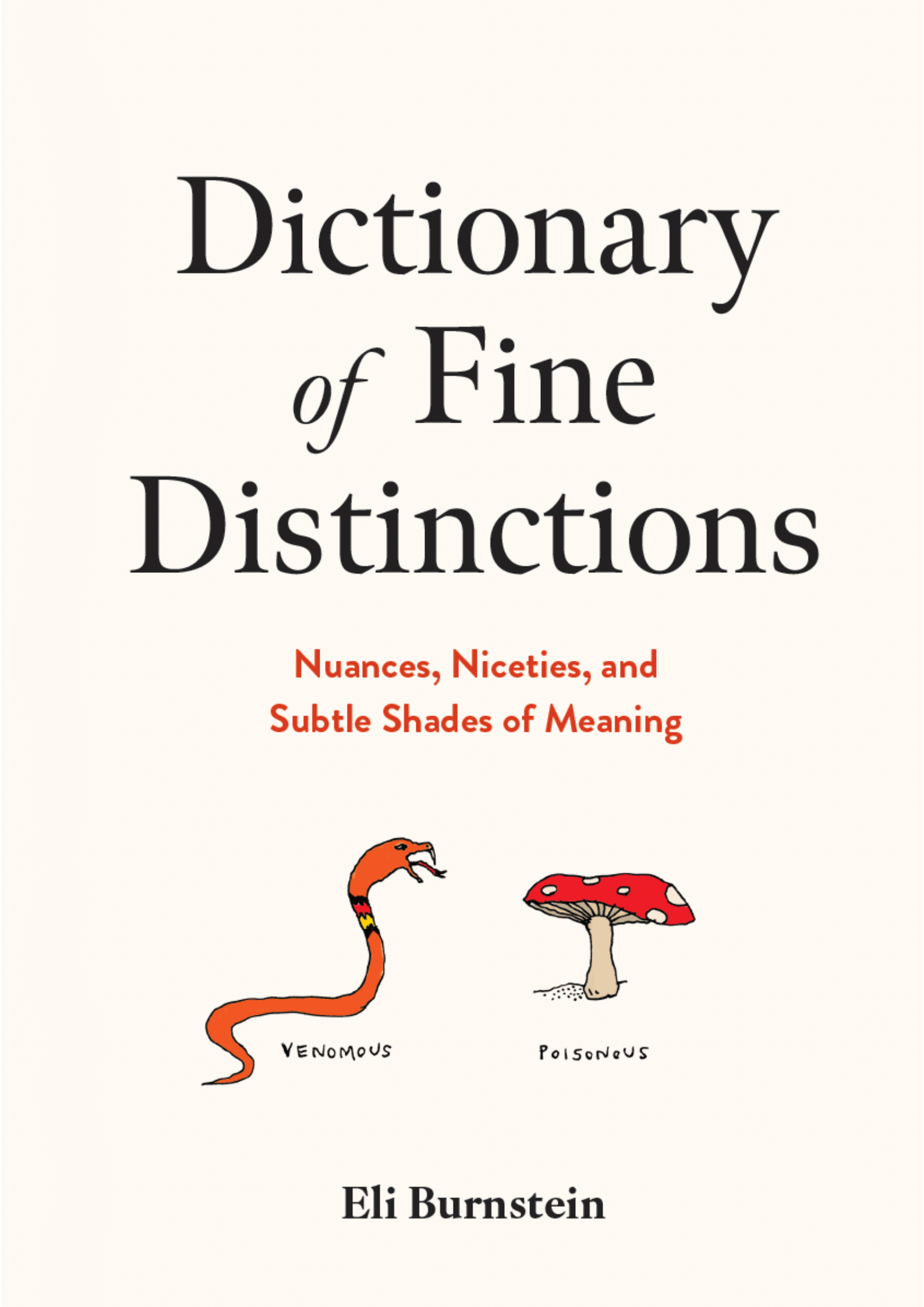
"Dictionary of Fine Distinctions" by Eli Burnstein

This is a fun and quick read, but unfortunately I found it patchy and unsatisfying.  Perhaps my expectations had been set too high by similarly styled books that offer a more rigorous treatment of their subject.  This is difficult to review, because I’m not sure that the book even knows what it is.  On the cover it is a dictionary, and inside it describes itself as a “synonymy” and an encyclopedia.  The words “dictionary” and “encyclopedia” imply a level of rigor, completeness and organisation that the book isn’t really pretending to have (and as far as my limited research goes, “synonymy” refers to the state of being synonymous, so can’t even be used to describe a book in that way).  If anything, I guess it’s a collection, a ragbag, a miscellany, an assortment… if only I had some kind of dictionary where I could distinguish between those words and choose the right one.

The book bounces between different levels of detail: straight out of the gate there is a very terse comparison of “emoji” vs. “emoticon” followed by a surprisingly complex discussion of the foam in various types of coffee.  For some of the brief explanations of words that I was already familiar with, I sometimes found myself thinking “I’m sure it’s more nuanced than that”, and then found that there were extra details in the endnotes that added more clarity - and it’s not clear why those weren’t integrated with the main text.  And there is a mixture of concepts (envy vs. jealousy, ethics vs. morality, shame vs. guilt) and things (leggings, tights, pantyhose and stockings) with no apparent ordering or organisation.

There are certainly plenty of “Aha!” moments, and it did have that quality of drawing me in by offering me “just one more…” before I put the book down.  And the illustrations are whimsical and nicely drawn.  This would be a great book to occupy yourself with while you’re on the toilet - but I feel that that’s not much of a recommendation for a book.

Thank you Edelweiss, Union Square & Co., and the author for the free review copy of Dictionary of Fine Distinctions in exchange for an honest review. All opinions are my own.

My rating: ★★★☆☆

Thursday, February 22, 2024

"Billy No-Mates: How I Realised Men Have a Friendship Problem" by Max Dickins

I so wanted this to be a good book, but ended up with very mixed feelings.  The author, Max, is getting married, but doesn’t have anyone to pick as Best Man.  Thus begins an odyssey exploring friendship - specifically the friendships largely experienced by men(*).

On one level, this is a book about the problems of loneliness and lack of close friendships.  There are some real issues here - for example when someone’s friendship group consists mostly of people from work, local clubs, or as parts of friendships with other couples that their partner largely manages.  There is a real issue of loneliness that can be experienced when life changes remove these friendship groups (leaving work, moving home, breaking up with a partner).  And for many people, the maintenance of friendships outside of these contexts is something that doesn’t come naturally, and therefore is often missing.

Some of the reasons for these crises are explored, and the book is very well researched, with extensive footnotes and endnotes, and features conversations with experts in every area.  There are some genuinely perceptive observations about the nature of friendships, and the issues some people find in initiating and maintaining them.  There are some very good examples of organisations that exist specifically to address these issues (for example, the various ‘sheds’ initiatives).

There is a lot of insight here, and I could relate to a lot of what was discussed.

The other side of the book is the author’s personal journey through his own friendships.  This is told through the lens of trying to identify a best man for his upcoming wedding, and works as a vehicle to explore the issues I’ve mentioned above.  But at the core of it, this feels like a “my diamond shoes are too tight” problem, as it turns out that Max has a significant circle of friends that he’s just fallen a bit out of touch with - there are 150 guests at his wedding.  The search for a best man also acts as a story arc that tries to bind the book together, with the inevitable happily-ever-after ending.  As the book came to a close, I found this to be glib and smug, as the author almost lords his newly rejuvenated group of friends over the reader.

So a mixed bag of useful insight and smug self-satisfaction.  At the end of the book I ended up feeling worse rather than better, which I think means that the book seriously missed the mark.  The 3 stars are for the genuinely useful content.

(*) I'm not going to comment on the gender issues here.  I suspect that many people will identify with the type of friendships the author is describing in the book.  The author also attempts to address this in a paragraph “A Quick Note from Max” at the beginning of the book.

My rating: ★★★☆☆

Monday, January 29, 2024

"To Be Taught, If Fortunate" by Becky Chambers

This story chronicles the activities of four astronauts as they catalogue the life on four planets, light years from Earth.  The plan is to catalogue the planets and then return to Earth.

This is a gentle, slow paced book, packed with detail of the day-to-day life of four people doing science, and maintaining their space craft, on alien worlds.

There is no peril.  There are no fights.  There is no conflict.

The two mechanisms that enable this adventure are: suspended animation (”torpor”) during space flight, which is fair enough; and “somaforming”, which allows the people to adapt to the environment, rather than needing to adapt the environment to the people.  The latter is an interesting concept that I hadn’t come across before.  There is no physics-defying magic that allows the astronauts to travel (or communicate) faster than light, so distance from Earth, and the time it takes communication to travel either way, is also a character in the story.

Nothing really happens.

The descriptions of the activity of doing science and the day-to-day social interactions of four astronauts in a moderately confined space are detailed and thoughtful.  There is a grounded sense of reality to what they are doing.

This is a novella, so there is little opportunity to explore many things in detail.  The impact of torpor and somaforming are briefly explored, and the character development is enough to get a sense of four different people, but no more than that.  The narrative space that this leaves is filled with description of the activities of the astronauts, and this description is quite engaging.  There is a real sense of “doing science”, and the author has gone to some lengths to describe a few niche pieces of science that crop up on the four planets - although this can feel a bit like a TED talk at times, when I felt like I was being educated rather than told a story.

So if you’re happy with sci-fi that focusses on description rather than plot or character, then this may be for you.  Personally, while I appreciated the detail and the sense of gentle activity that I felt throughout the book, I found that ultimately I didn’t really care about the people or their situation.  So my rating for this book has more to do with my subjective experience than the quality of the writing.  This book may be for you.  It just wasn’t for me.

My rating: ✦✦✦✧✧

Wednesday, January 10, 2024

"The Night I Spent with Aubrey Fisher" by Christopher M. Tantillo

I’m very conflicted about this book. I really wanted to give it a higher rating, but in the end, I felt that a potentially great story was let down by execution.

As per the blurb, Grayson’s life is in turmoil since the death of his little brother, for which Grayson (”Gray”) blames himself. Aubrey Fisher, a misfit foster child, comes into his life, and they spend 24 hours together.

There are powerful themes in this book - most notably suicide ideation. This has to be handled sensitively, and it was (the Acknowledgements at the back of the book explain that many of the themes are issues that the author has dealt with in his own life).

First, the good: I really liked the character of Aubrey. Her depth of emotion seemed real to me, and I wanted to get to know her better - there was a point in the book that I cried in response to learning something about her past. The story is told in the first person from the perspective of Gray, largely through dialogue, so the fact that Aubrey felt so alive to me speaks to the skill of the author. The supporting cast of friends (Kris, Jenna, Kyle, Tim, Reefer) were also well drawn (although Tim and Kyle seemed a bit interchangeable), and I could really feel the shared history between this friendship group: the glue that holds them together amongst the inevitable bickering and tension.

I also enjoyed the plot. The story of Aubrey and Gray’s escapades in this 24 hours was engaging and satisfying. And, although the ending was largely how I expected it, the journey carried me along throughout.

But, while I liked Aubrey, she had a wisdom beyond her years that I found jarring. She has a chequered background, and some questionable current behaviour, but she somehow has a crystal clear idea of what’s important, and what people need in order to get through life in the presence of severe emotional trauma. Some of her own traumatic background is touched upon, and contributes to her depth of character, but I just found it infeasible that she would be so worldly-wise given her age and life experience.

I also couldn’t connect emotionally with Gray at all - which is a problem, given that this story revolves around Gray’s intention to kill himself in response to the death of his little brother. This is also surprising, given that the story is written from Gray’s point of view (and doubly so given how real Aubrey’s emotions felt to me). My inability to connect emotionally with Gray meant that his intention to kill himself also didn’t seem real to me - it felt like an intellectual idea to end his life rather than a driving emotional need. So my personal experience of reading the story was that Gray was never in any real danger of taking his own life, but had an interesting and transformative 24 hours with the misfit kid from school. And, while I still enjoyed reading it, I’m sure this isn’t what the author intended.

The book is structured as a series of chapters, each covering one of the 24 hours. While this is a neat device, it meant that the story seemed to drag a little near the beginning where very little was happening in each hour. At one point it also meant that Gray ended up waking someone up in the early hours of the morning in order to have a conversation with them - which seemed like it had to be crowbarred into the remaining ‘per hour’ structure of the book in order to tie up some loose ends.

The style also got a little preachy at times, and there were a few too many “You see, Timmy” moments where the moral, meaning and conclusions of the story were explained in excruciating and slightly patronising detail.

So, for me, a potentially great story let down by execution.

My rating: ★★★☆☆

Saturday, November 18, 2023

"Dogboy v Catfish" by Luke Gracias

This is a moderately engaging police procedural.

The blurb is so concise that I’ll repeat it here:

“The police investigation into Dogboy's disappearance leads them into the dark world of counterfeit designer goods, money laundering, and drug smuggling. With Dogboy's assets frozen and the mob protecting their interests, the missing persons case escalates to homicide. Catfish is in a race against time to get hold of Dogboy's assets before the police get hold of her. One question remains - is Dogboy dead or alive?”

Yes. That’s exactly what happens. Nothing more. Nothing less.

The plot holds together, but there are no real surprises, and each chapter just felt like turning the handle to move one step further towards the end. The perfunctory writing style added to this same of trudging through the book - often seeming like a checklist of activities that each character needed to be doing. Some randomly spurious details thrown in from time to time: “Sabina had her Canon DSLR with the 400 mm zoom pointed across the street” (the only relevance here being that it was a camera) - perhaps this was the author’s attempt to inject more realism, but it just felt like padding to me. The characters were distinct, but lacking depth.

So… engaging enough for me to get to the end - that’s all.

Thank you #NetGalley and the author for the free review copy of #Dogboyvcatfish in exchange for an honest review. All opinions are my own. 

My rating: ★★★☆☆

NetGalley Review

Friday, September 15, 2023

"Doppelganger" by Naomi Klein

For me, this is a difficult book to review. The author has some important, insightful and well researched observations about the behaviour of significant sections of the population that I have previously found bewildering and difficult to comprehend: conspiracy theorists, deniers of various kinds, and those that would liken minor lifestyle inconveniences with the atrocities perpetrated by the Nazis. However, the book felt in places like a disjointed ragbag of ideas that were loosely (sometimes very loosely) tied together by the Doppelgänger theme - a theme that often felt slightly forced, or crowbarred in to justify talking about a particular topic in the context of the book.

Given the disjoint nature of the book, I was also left unsatisfied regarding any overall conclusion. The suggestion that we should work together, rather than as individuals, to address many of the problems we are currently facing seems shallow and weak - especially compared to the depth and strength of some of the issues covered, and the detail with which they have clearly been researched.

After reading this book, I do feel like I have more insight behind what might be driving some mass behaviours that I otherwise found incomprehensible - but I don’t know where that leaves me. I certainly don’t feel any better equipped, nor more hopeful - so I feel I may have missed something.

Thank you #NetGalley and Penguin Press UK for the free review copy of #Doppelganger in exchange for an honest review. All opinions are my own.

My rating: ★★★☆☆

NetGalley Review

Saturday, July 1, 2023

"The Brill Pill" by Akemi C. Brodsky

This book explores the issue “just because you can doesn’t mean you should” through the eyes, and internal monologue, of a deeply flawed character who, nevertheless, has the scientific knowledge to change the lives of thousands of people.

The core idea is interesting - of a world in which lives can be changed by brain regeneration, but many of the recipients are never quite the same. And the internal struggles of someone who can influence the science or act covertly to subvert it, should have been interesting and engaging.

Unfortunately for me, the balance of narrative concentrated far too much on the the internal monologue of the main character, Will. I would have preferred more depth in some of the other characters, and a slightly faster pace in the plot. There are plot elements that should have had excitement, suspense, or jeopardy, but that fell too flat for my liking. Many of these were told through the experience of Will, who was often simply finding ways to procrastinate, avoid issues, or agonise over which course of action to take.

A fascinating premise and an interesting story, though.

Thank you #NetGalley and She Writes Press for the free review copy of #TheBrillPill in exchange for an honest review. All opinions are my own.

My rating: ★★★☆☆

NetGalley Review

Wednesday, May 31, 2023

"Hag-Seed: the Tempest Retold" by Margaret Atwood

Hag-Seed is a retelling of The Tempest, as part of the Random House “Hogarth Shakespeare” series. Although I knew it was a retelling of The Tempest when I bought it, I’m not familiar with The Tempest, and I had hoped that it would stand up as a novel in its own right. I had high hopes from an author of the calibre of Margaret Atwood.

The quality of the writing and the characterisation are excellent. The main character, Felix, has complexity and depth in the portrayal of his emotions around the production of the play, and for his daughter. The supporting women - Anne-Marie and Estelle - also feel alive and distinct, and I enjoyed all of their interactions. The supporting cast of in-mates was solid, but lacked a little variation - possibly due to the need to include so many characters due to the source material.

However, I found the plot a little slow moving and uninspired (which is ironic, given the inspiration). A lot of time is taken in the middle of the book around the development of the play which seems somewhat repetitive and slow moving, and the resolution of the main plot seems hurried, with the ultimate outcome slightly difficult to believe.

I suspect that my dissatisfaction with the plot was due to the author’s desire to echo elements of The Tempest in the plot (although I’m not sure about this, due to my unfamiliarity with The Tempest). And while this may have drawn knowing appreciation from those familiar with the source material, any in-jokes and clever parallels were lost on me.

So overall, engaging and interesting characters, but a disappointing plot.

My rating: ★★★☆☆

Tuesday, April 25, 2023

"Myriad" by Joshua David Bellin

I always find stories involving time travel an enjoyable challenge. It is always interesting to see how the author handles the potential for paradoxes, as characters travel back and potentially change the course of history. Myriad doesn’t disappoint in this regard, with the rules and consequences of time travel slowly revealed as the plot progresses.

This is a plot driven book, and the action keeps up at a good pace, while the central mystery of who is pulling the strings remains a compelling thread throughout the story.

The title character, Myriad, is likeable enough, but I didn’t find the characterisation particularly deep or moving - which is a shame, given the importance of the relationship with her brother and mother.

And, while this is a book about time travel, I found some of the rules and consequences of time travel inadequately explored or explained - and this was a shame, as the book has an interesting perspective on some of the rules and consequences of time travel that I hadn’t previously come across.

While these issues prevented me from giving a higher rating, they did not stop Myriad from being an enjoyable read, and the final reveal and conclusion I found satisfying.

Thank you #NetGalley and Angry Robot for the free review copy of #Myriad in exchange for an honest review. All opinions are my own.

My rating: ★★★☆☆

NetGalley Review

Monday, April 10, 2023

"Red Team Blues" (Martin Hench #1) by Cory Doctorow

Red Team Blues is a plot-driven detective story told in Cory Doctorow’s distinctive style of high tech internet sub-culture.

The main character of Marty Hench is engaging, and the plot clips along at a good pace, with a good supporting cast of characters. I genuinely wanted to know how everything turned out, and cared about the fate of Hench and his friends.

Doctorow manages to keep the writing accessible and engaging, while also talking about some quite complex technology (in this case cryptocurrency and blockchain). This is done in a way that effectively illustrates how immersed the characters are in this high tech world, without spoon feeding the reader with explanations and exposition that might get in the way of that momentum of the plot - there is just enough explanation to support the narrative and the important aspects of the plot.

While the plot does carry you along, I couldn’t help feeling there was a lack of depth in both the main arc of the plot, and some of the characters. For me, many of the supporting characters were a little too similar, and their personalities not explored or differentiated enough. This didn’t spoil what was a fun and engaging read, but did prevent me from giving a higher rating.

Thank you #NetGalley and Head of Zeus for the free review copy of #RedTeamBlues in exchange for an honest review. All opinions are my own.

My rating: ★★★☆☆

NetGalley Review

Tuesday, March 28, 2023

"Bibliomaniac: An Obsessive's Tour Of The Bookshops Of Britain" by Robin Ince

An amiable book about an amiable book tour. It carried me along for the ride nicely, and made me want to see Robin Ince again next time he’s touring.

My rating: ★★★☆☆

Popular Posts