Monday, April 1, 2024

"The Other Valley" by Scott Alexander Howard

Some stand-out moments in this unique but flawed story of time travel that deals with themes of loss, obedience, conformity, consequences and missed opportunities.

3.5 stars rounded down.  I don’t usually award half stars, but I’m so conflicted about how to rate this book that I don’t feel like I have any other option.

A brief summary from the blurb:

"West is twenty years in the past.

East is twenty years in the future.

Would you travel through time to save the one you love?

Sixteen-year-old Odile Ozanne finds herself drawn into a devastating lifelong dilemma – to preserve the town’s carefully protected timeline, or to risk everything and try to rescue her one chance at happiness."

The time travel set-up interesting, and unique in my experience: the story is set in a valley bounded by mountains to the east and west.  Beyond the mountains lie the same valley, but 20 years in the past the the west, and 20 years in the future to the east.  This is an imaginative set-up for time travel.  For me, though, it left significant questions unanswered that I found an ongoing distraction (more on that later).

A feeling of disconnection

First, let’s deal with the elephant in the room: there are no quotation marks.  Direct speech is indicated by a paragraph break (although not always) along with the reader’s intuition that someone is now speaking due to the change in flow and tone.  The story is told in the first person and there were quite a few times when I was genuinely confused about whether a sentence like “I didn’t know” was part of the first person narrative, or was being spoken by the narrator, or was being spoken by one of the other characters.  I think I mostly got it right from context, but why is the author making me work so hard?

I have no problem with an author playing with convention and form for stylistic reasons or to provide a particular feel - but I simply didn’t see the point of the lack of quotation marks.  Worse than that, not only did it get in the way of the reading experience, but it also got in the way of my engagement with the story and the characters.  For me, the lack of quotation marks added distance - as if all of the speech was either badly remembered, or was being reported third-hand.  It had the disconnected feel of a badly dubbed foreign film.

This brings me to characterisation.  I’m not sure whether the main character, Odile, was supposed to be somewhat neurodivergent - with sentences like “startled, I forgot to smile back” seeming to indicate the processing of emotions being a deliberate activity - or perhaps she was just supposed to be shy.  Either way, she is written with an emotional detachment, and seems to be on the sidelines for many of her experiences and relationships with other people.  Unfortunately for me, this also meant that I had no sense of the depth of her emotion for her best friend, Edme, whose fate is pivotal for much of the plot.  I did wonder whether this was just my own disconnection with the author - that perhaps the author wasn’t going to be able to make me feel anything for any of the characters - but this wasn’t the case: I found one of the scenes where Odile escorts an old man into an adjacent valley very moving.

The Time Travel Mechanism

I had so many problems with the time travel mechanism, where valleys to the east and west are 20 years removed…

Firstly, the entire world in which the story unfolds is only a few kilometres wide, but the society is advanced enough to have buses and cars.  This means that there needs to be a certain amount of heavy industry: mining, steel works, petrochemicals, manufacturing, etc.  This is briefly alluded to at one point (“The pavement ended and the streetlights tapered off at the gloomy remains of the brickyard and some factories. There was no more need for them to operate, the Conseil said“), but a few factories isn’t enough.  Worse than this, the valley is also bounded to the north and south - the valley is the entire world.  It’s not like there is an “industrial zone” elsewhere that would explain this.  Of course, none of this is important to the plot, but I found it very distracting.

Secondly, the “single timeline” rules of time travel in this book would result in an incredibly delicate hold on a stable reality.  Changes in the past (the west) will impact the future (the east).  In fact, this is poetically described at one point: “A person goes west, he interferes, and then new time rolls over him like a wave, leaving nothing behind. It’s as simple and ruthless as that.”  This set of timeline rules is fine in principle, and is well established in speculative fiction in general.  However, when this is combined with the “walk west and you end up 20 years in the past” mechanism in this book, then the entire world becomes very fragile.  The purpose of the “Conseil” in the book is to police movement between valleys, due to the consequences to the timeline of uncontrolled attempts to interfere with the past.  However, we’re supposed to believe that the valleys go east and west without end - that they are effectively infinite.  This means that the Conseil has to have a perfect record in every one of the infinite valleys to the west in order to prevent waves of updated time continuously crashing eastwards through the valleys.  This seems unlikely.  And what about a bird (because there are birds) flying west and, for example, causing a car accident?  This delicacy of the timeline is essential to the plot, and yet is inherently infeasible.

The Good Stuff: Plot and Character

One final negative word before the good stuff: the pace is incredibly slow, and the balance of story establishment vs payoff is too skewed towards story establishment for my liking.  For me, the payoff of all of the world building and character development kicked in at 80-90% of the way through, which represents quite a lot of slogging through world building up to that point.

However, the payoff was very satisfying.  For all that I’ve criticised the distracting elements of style and world building, I found the progression of the plot (who ends up where, and for what reasons) to be surprising and enjoyable - there were points where the plot took a sharp turn in a way that I wasn’t expecting, and I really appreciated that.

The blurb would have us believe that the book is about lost love and redemption - the chance to bring back something that’s been lost.  And while it is about that, the “something that’s been lost” runs so much deeper than a relationship with a childhood friend.  Compliance to authority for the greater good in the face of personal loss is a theme that runs throughout the story.  Coming to terms with regret and lost opportunity is also a persistent thread - and a thread that is made poignant by the tantalising prospect of being able to travel back in time and interfere, in an attempt to change outcomes.  And it’s in the main character’s self-absorbed, introspective contemplation on the direction that her life has taken in the face of all of this that the author’s characterisation really shines.  Odile’s combination of regret, resignation, and conflict later in the story ultimately gave her the sense of depth and reality that I was hoping for - and that’s what will stay with me from this book.

Thank you #NetGalley and Atlantic Books for the free review copy of #TheOtherValley in exchange for an honest review. All opinions are my own.

My rating: ★★★☆☆
NetGalley review

Friday, March 29, 2024

NetGalley Genre Misfire

NetGalley is a great way to get an early look at books that might turn into the "next big thing".  For those of us who read a lot, it's also a handy way to get free access to books you might enjoy.  My initial enthusiasm for NetGalley came from the latter (free books!), but it's now overlaid with a smidge of wisdom that came from some early experiences with NetGalley that didn't go entirely to plan:

Soon after I'd joined NetGalley I got an email from them promoting requests for Doppelganger: A Trip into the Mirror World. I was still dizzy with the prospect of free books from NetGalley, and this was my first email from them. I blindly assumed they'd filter their emails according to my preferred Categories on their web site (which they clearly don't). Armed with my giddy naivety, I skimmed the book description, thought it sounded like an interesting near-future speculative fiction book, hit 'Request', and thought no more about it.

Epic genre misfire.

If you read the blurb with your eyes half closed and an expectation that it falls into NetGalley's "Sci Fi & Fantasy" category, and you may be able to kind-of see how I misinterpreted it. My excitement at being Approved was short-lived, but, being new with NetGalley, I didn't want to torpedo my own Feedback Ratio, so I dutifully read and reviewed it.

You may laugh now.

Although, in a quirk of irony, it's now my most popular Goodreads review by quite a margin.

Monday, March 25, 2024

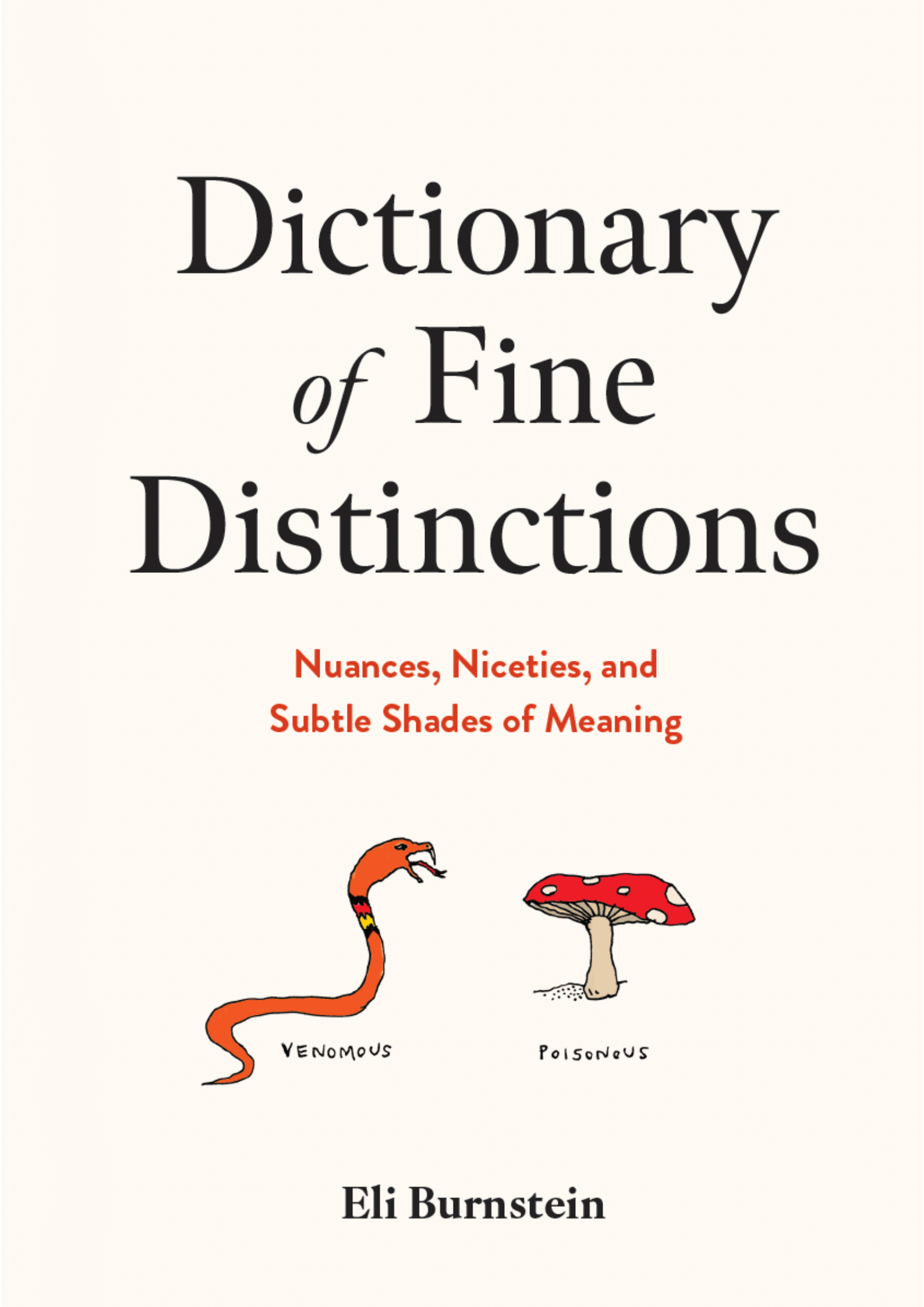
"Dictionary of Fine Distinctions" by Eli Burnstein

This is a fun and quick read, but unfortunately I found it patchy and unsatisfying.  Perhaps my expectations had been set too high by similarly styled books that offer a more rigorous treatment of their subject.  This is difficult to review, because I’m not sure that the book even knows what it is.  On the cover it is a dictionary, and inside it describes itself as a “synonymy” and an encyclopedia.  The words “dictionary” and “encyclopedia” imply a level of rigor, completeness and organisation that the book isn’t really pretending to have (and as far as my limited research goes, “synonymy” refers to the state of being synonymous, so can’t even be used to describe a book in that way).  If anything, I guess it’s a collection, a ragbag, a miscellany, an assortment… if only I had some kind of dictionary where I could distinguish between those words and choose the right one.

The book bounces between different levels of detail: straight out of the gate there is a very terse comparison of “emoji” vs. “emoticon” followed by a surprisingly complex discussion of the foam in various types of coffee.  For some of the brief explanations of words that I was already familiar with, I sometimes found myself thinking “I’m sure it’s more nuanced than that”, and then found that there were extra details in the endnotes that added more clarity - and it’s not clear why those weren’t integrated with the main text.  And there is a mixture of concepts (envy vs. jealousy, ethics vs. morality, shame vs. guilt) and things (leggings, tights, pantyhose and stockings) with no apparent ordering or organisation.

There are certainly plenty of “Aha!” moments, and it did have that quality of drawing me in by offering me “just one more…” before I put the book down.  And the illustrations are whimsical and nicely drawn.  This would be a great book to occupy yourself with while you’re on the toilet - but I feel that that’s not much of a recommendation for a book.

Thank you Edelweiss, Union Square & Co., and the author for the free review copy of Dictionary of Fine Distinctions in exchange for an honest review. All opinions are my own.

My rating: ★★★☆☆

Thursday, March 21, 2024

"Alien Clay" by Adrian Tchaikovsky

This is a gripping and fast-paced adventure set on a very alien world.  The world buiding is excellent, and the “alienness” is so well depicted that it I had a creepy sense of foreboding throughout a lot of the book.

A plot summary from the blurb:

On the distant world of Kiln lie the ruins of an alien civilization. It’s the greatest discovery in humanity’s spacefaring history – yet who were its builders and where did they go?

Professor Arton Daghdev had always wanted to study alien life up close. Then his wishes become a reality in the worst way. His political activism sees him exiled from Earth to Kiln’s extrasolar labour camp. There, he’s condemned to work under an alien sky until he dies.

For me it was a page-turner from the very beginning - it was engaging and well paced, and I enjoyed the slightly flippant first-person narrative.  This is my first Adrian Tchaikovsky book, but if this is his writing style, then I’ll definitely be reading more.  One odd stylistic quirk: the author broke the fourth wall a few times - talking directly to the reader.  It wasn’t clear what the purpose of this was, and I was expecting it to become relevant at some point - which it didn’t.  This didn’t detract, but I did wonder what the point was.

The world building is so well integrated with the plot that it felt effortless.  And it had a lot of ground to cover - from the Mandate, an ideological quasi-scientific/relgious organisation with totalitarian control over Earth’s society, to the flora and fauna of an oh-so-alien planet, “Kiln”, that Daghdev gets exiled to.  And it’s that alienness that I really enjoyed about the book - it was somehow simultaneously seductive and replusive.

The plot has jeopardy from start to finish, but this really ramps up about two-thirds of the way through the book.  Events unfold that emerge beautifully from the world building - the potentially extreme risks of the situation the characters find themselves in have been so well established that the consequences are obvious without having to be described.

So why not 5 stars?  Only because it’s not a book that will stay with me.  The plot and characters were enjoyable and engaging in the moment, but I’m not sure I’ll remember them a few months from now.  I enjoyed the alienness, but it won’t stay with me in the same way as the unknowable alienness in "Solaris" by Stanislaw Lem, for example.  None of that stopped it from being a cracking adventure, though, and I’d happily recommend it to anyone looking for that.

Thank you #NetGalley and Pan Macmillan Tor for the free review copy of #AlienClay in exchange for an honest review. All opinions are my own.

My rating: ★★★★☆

NetGalley review

Tuesday, March 12, 2024

"Chernobyl: The Fall Of Atomgrad" by Matyáš Namai

This graphic novel beautifully and concisely depicts the events surrounding and following the 1986 Chernobyl nuclear disaster.  It is short, but intricately told, with a pitch perfect balance in the storytelling of bureaucratic failure, technical detail, unsung heroism, and the impact on the immediate and ongoing lives of those involved.

The art style uses a limited palette of of muted blues and yellows, presumably as a mark of respect to the region, as well as being an expressive stylistic choice.  The overall effect seemed reminiscent of the Constructivist style (at least to my untrained Western eye), which felt appropriate, and I really appreciated.

The storytelling moves effortlessly from being direct, punchy and sometimes shocking, through to gentle, pastoral and almost poetic in places. 

Overall this is an incredibly accessible, evocative and, in places, moving retelling of the Chernobyl disaster.  I was pleased to see historical and technical experts credited, giving me confidence in the accuracy of what is portrayed.  I only wish that I had had something like this when I was at school - and then perhaps I would have spent more time studying history.

Thank you #NetGalley and Palazzo Editions for the free review copy of #Chernobyl in exchange for an honest review. All opinions are my own.

My rating: ★★★★★

NetGalley Review

Monday, March 11, 2024

"The Space Between Worlds" by Micaiah Johnson

By the end of this book, I was deeply invested in the main characters.  I loved it.  I delayed reading the last chapter so I could savour being in their world a little longer.  I’m so tempted to give to give it 5 stars, especially while my book hangover is still raw.  But I have to acknowledge where it didn’t fully hit home.

First, a small snippet of blurb as a précis…

Multiverse travel is finally possible, but there’s just one catch: No one can visit a world where their counterpart is still alive. Enter Cara, whose parallel selves happen to be exceptionally good at dying—from disease, turf wars, or vendettas they couldn’t outrun. Cara’s life has been cut short on 372 worlds in total.

Cara’s slim grip on life in so many of the parallel worlds makes her ‘Earth Zero’ self ideal to work as a ‘traverser’, gathering intelligence from parallel worlds that are sufficiently similar to Earth Zero.  And so the scene is set.

The main conflict in the story comes from the two-tier society that has developed on Earth.  There is the wealthy, enclosed, Wiley City, where the company “Eldridge” runs everything to do with multiverse travel; and there is Ashtown, in the area outside the city where pollution and poverty have a firm grip.  Cara comes from Ashtown, but works for Eldridge in Wiley City.  Cue conflict and tension.

Wiley City is believable as a community of the elite, with various levels of privilege, but it is in Ashtown where the author’s world building really excels.  Here there is a gritty, multi-facetted society with power structures that have evolved around religion, prostitution, and a self-styled Emperor with his fearsome teams of Runners that wield his power.  I could almost taste the dirt in Ashtown, and the power struggles were so well crafted that I fully understood the consequences of a wrong word here, or an unintended insult there.

And the writing style.  I loved the writing style.  I could just marinate in it.

An economy of words that could be evocative, blunt, eloquent, direct, poetic, or just plain gorgeous.  I so often found myself smiling from the little rush of joy I would get from a phrase or paragraph that felt like a little nugget of perfection - even when it was used to illustrate something cruel or callous, to fill in the colour in a character’s motivations.

So what’s not to like?

I really struggled with the first 20% or so of the book.  This is where the heavy lifting was done for the world building.  This was establishing Cara’s credentials as having come from Ashtown, with a hardness of character and a set of sensibilities that have allowed her to survive, when so many of her parallel world selves didn’t.  And I really didn’t like her very much.  Then there is an extended visit to a parallel Earth that takes the remainder of the first half of the book.  Again, this is critical world building, and was quite enjoyable as it was beginning to benefit from a pay-off of the earlier character establishment.  And the consequences and differences of parallel worlds started to become really interesting.  But I still didn’t understand where the story was going.

It was only in the second half of the book that the full pay-off for all of the world building and character establishment really kicked in.  And then it *really* kicked in.  The second half of the book was an exciting ride of twists and dense plot - fully taking advantage of all of the world building that had been done across multiple parallel worlds.  This is where I really started to engage with the characters, and get to like so many of them… and I enjoyed it immensely.

So while the second half of the book is 5 stars through and through, I can’t fully forgive it for my struggles in the first half.

But here are some other random things that I enjoyed:

  • The central conceit that it is only Earth Zero that initiates traversing isn’t ignored or glossed over, but is quite neatly explained, and even contributes to the plot. I appreciated this not-so-little detail, that is missing in some other parallel worlds stories.
  • At the 50% point in the book, I made a prediction about what would happen to one of the main characters by the end of the book. And although it turned out that I was wrong, there was a moment when the character contemplated that course of action and rejected it. That felt like the author rewarding me twice: once as a nod to me having predicted it, and again for providing me with something else that was ultimately more satisfying.
  • The mechanism for traversing was only obliquely ‘explained’, but is clearly intended to be entirely based on science and technology. However, the traversers themselves had developed a little mysticism around it that I found incredibly human.

Until this book hangover subsides, I will continue to find it intrusive and an invasion of privacy that other people have read this book, and may have become as attached as I have to so many of the characters.

It will pass.

My rating: ★★★★☆

Friday, March 1, 2024

"Klara and the Sun" by Kazuo Ishiguro

Klara is an android, an “Artificial Friend”, an AF.  It is a world in which AFs are habitually used as companions for children, and Klara is bought by a family for their ailing daughter.  This is their story, told from Klara’s perspective.

It’s difficult to succinctly say what the core theme of the book is - what the book is ‘about’ - as there are three threads that play equal parts and weave around each other throughout the story.

Firstly, there is the use of AI and robotics, and how they can be used to displace people in a variety of roles - the most obvious being the use of AFs as companions for children.  Klara’s role is depicted as being a positive experience for the family that she becomes part of, but there are glimpses of where relationships between AFs and their associated children have become dysfunctional.  

The story is told from the first-person perspective of Klara, so it is implicit that Klara is conscious and sentient - she is, afterall, the narrator.  And yet AFs are treated as property, and Klara unquestioningly accepts that - indeed, is happy to be bought by a family.  These broader themes, and the societal impact of using AFs in other contexts, such as displacing people from their jobs, are hinted at but not explored.

Another thread, almost entirely independent of the use of AFs, is the practice of using medical intervention to ‘enhance’ children (referred to as ‘lifting’ in the book), using hinted-at procedures that are not without risk.  The ethics of this decision, along with the two-tier society that can result, are not dealt with head-on, but instead form a foundation for much of the conflict within the story, and the emotional struggles of some of the characters.

And then there is the internal life of Klara herself, and the reason for the title of the book.  The story is told through a lens of naïvety as Klara learns about the world around her.  Klara is described as an AF with particularly good observational skills, and she learns about the world around her mostly through observation - drawing conclusions and inferring cause and effect from what she sees around her.  However, this unguided observational learning leads Klara to believe that the Sun (yes, the fiery ball in the sky) has omniscient and mystical power.

This belief in the Sun leads Klara to interpret other events around her as cause and effect, which she then struggles to make sense of - largely due to the inscrutable nature of the Sun’s decision-making process.  The parallels with religious faith are clear, and it’s difficult to know what message the author is trying to convey, given some of the questionable behaviour that Klara engages with as a consequence of her belief, and the ultimate outcome of the story.

The world building is very satisfying, and the glimpses of the various issues, ideas and concepts that come out of it are intriguing and thought-provoking.  With such broad scope, it’s inevitable that very little is dealt with in depth.  While there were many things that could have been explored in more detail, I wasn’t left frustrated that they weren’t - rather, I enjoyed skirting around the edges.

My rating: ★★★★☆

Popular Posts